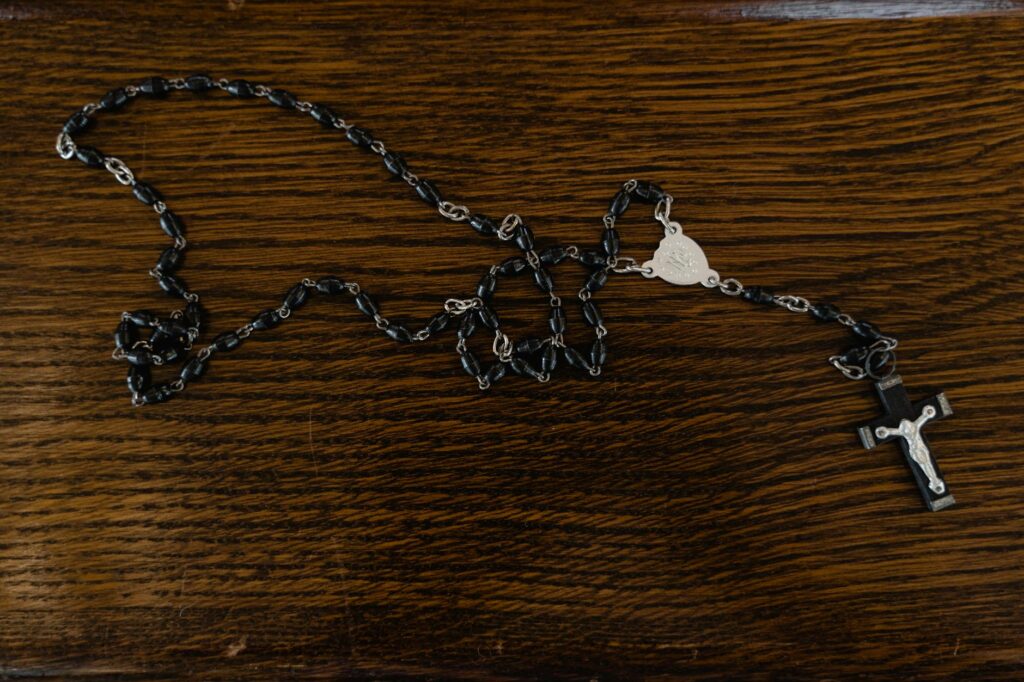
A complete guide to the prayer Our Lady gave the Church — its beads, its mysteries, its promises, and the quiet way it teaches a soul to look at Christ through the eyes of His Mother.
✠
CatholicSayDevotional Guide
≈ 20 minto pray one set
Dailyfor centuries
The Rosary is a school of contemplation in which the mysteries of Christ are learned from Mary herself.
The Rosary is not, at heart, a set of prayers to be finished. It is a way of looking — a slow, unhurried gaze at the face of Christ through the memory of His Mother. The beads are there only so the hands have something to do while the soul does the real work: remembering.
If you have never prayed one, or you have started a hundred times and lost your place, this page is for you. Everything you need — the prayers, the mysteries, the order, the promises, the questions everyone asks in silence — is below, in the order you will actually need it.
“The Rosary is my favorite prayer. A marvelous prayer — in its simplicity and its depth.”St. John Paul II
The Anatomy of the Rosary
A Rosary looks like beads on a string, but every bead has a purpose. The string of five decades below is what you hold in your hand. The short tail — crucifix, one large bead, three small beads, one large bead — is how every Rosary begins.
The Beads · A Diagram
What each bead is for
The tail (crucifix up through the centerpiece) is prayed once at the start. The loop is prayed five times through — each full lap is one decade, and five decades is one full Rosary. Most faithful pray five decades a day; a full Rosary traditionally means twenty, across all four sets of mysteries.
How to Pray It
Here is the entire order, in the sequence you will actually use it. Keep a finger on the next bead; your hand will learn the rhythm within a week.
On the Crucifix
Sign of the Cross Then pray the Apostles’ Creed.
On the First Large Bead
Pray one Our Father.
On the Three Small Beads
Pray three Hail Marys — traditionally for an increase of faith, hope, and charity.
On the Next Large Bead
Pray the Glory Be. Then announce the First Mystery and pray an Our Father.
On the Ten Small Beads of the First Decade
Pray ten Hail Marys, meditating on the mystery as you go — don’t rush.
After Each Decade
Pray the Glory Be and then the Fátima Prayer (“O my Jesus…”). Announce the next mystery on the large bead, pray an Our Father, and begin the next ten Hail Marys.
Repeat Until Five Decades Are Complete
At the end of the fifth decade, pray the Hail, Holy Queen and the closing prayer (“O God, whose only-begotten Son…”). Finish with the Sign of the Cross.
A Word From the Saints
“The Rosary is the scourge of the devil.”
Pope Adrian VI
The Four Sets of Mysteries
Twenty mysteries in all — five per set — distributed across the week. The Luminous Mysteries were added by St. John Paul II in 2002 (Rosarium Virginis Mariae). The traditional schedule is below, and it is the one most parishes still keep.
The Joyful Mysteries
Monday & Saturday
Christ Comes Among Us
The Annunciation Luke 1:26–38
The Visitation Luke 1:39–56
The Nativity of Our Lord Luke 2:1–20
The Presentation in the Temple Luke 2:22–38
The Finding of Jesus in the Temple Luke 2:41–52
The Luminous Mysteries
Thursday
Christ Reveals Himself
The Baptism of Jesus in the Jordan Matthew 3:13–17
The Wedding at Cana John 2:1–11
The Proclamation of the Kingdom Mark 1:14–15
The Transfiguration Matthew 17:1–8
The Institution of the Eucharist Matthew 26:26–29
The Sorrowful Mysteries
Tuesday & Friday
Christ Suffers for Us
The Agony in the Garden Luke 22:39–46
The Scourging at the Pillar John 19:1
The Crowning with Thorns Matthew 27:27–31
The Carrying of the Cross John 19:16–17
The Crucifixion and Death Luke 23:33–46
The Glorious Mysteries
Wednesday & Sunday
Christ Is Risen and Reigns
The Resurrection Matthew 28:1–10
The Ascension Acts 1:6–11
The Descent of the Holy Spirit Acts 2:1–4
The Assumption of Mary Revelation 12:1
The Coronation of Mary Revelation 12:1
The Prayers, in Full
Each prayer below opens to the full text. Where the Latin adds something the English cannot — a cadence, a chant, a memory of centuries — it is given alongside.
Sign of the Cross
read
English
In the name of the Father, and of the Son, and of the Holy Spirit. Amen.
Latin
In nómine Patris, et Fílii, et Spíritus Sancti. Amen.
The Apostles’ Creed
read
English
I believe in God, the Father almighty, Creator of heaven and earth, and in Jesus Christ, his only Son, our Lord, who was conceived by the Holy Spirit, born of the Virgin Mary, suffered under Pontius Pilate, was crucified, died and was buried; he descended into hell; on the third day he rose again from the dead; he ascended into heaven, and is seated at the right hand of God the Father almighty; from there he will come to judge the living and the dead.
I believe in the Holy Spirit, the holy catholic Church, the communion of saints, the forgiveness of sins, the resurrection of the body, and life everlasting. Amen.
Latin
Credo in Deum, Patrem omnipoténtem, Creatórem cæli et terræ. Et in Iesum Christum, Fílium eius únicum, Dóminum nostrum: qui concéptus est de Spíritu Sancto, natus ex María Vírgine, passus sub Póntio Piláto, crucifíxus, mórtuus, et sepúltus, descéndit ad ínferos; tértia die resurréxit a mórtuis; ascéndit ad cælos; sedet ad déxteram Dei Patris omnipoténtis: inde ventúrus est iudicáre vivos et mórtuos.
Credo in Spíritum Sanctum, sanctam Ecclésiam cathólicam, sanctórum communiónem, remissiónem peccatórum, carnis resurrectiónem, vitam ætérnam. Amen.
The Our Father
read
English
Our Father, who art in heaven, hallowed be thy name; thy kingdom come, thy will be done on earth as it is in heaven. Give us this day our daily bread, and forgive us our trespasses, as we forgive those who trespass against us; and lead us not into temptation, but deliver us from evil. Amen.
Pater Noster
Pater noster, qui es in cælis, sanctificétur nomen tuum. Advéniat regnum tuum. Fiat volúntas tua, sicut in cælo et in terra. Panem nostrum quotidiánum da nobis hódie, et dimítte nobis débita nostra, sicut et nos dimíttimus debitóribus nostris. Et ne nos indúcas in tentatiónem, sed líbera nos a malo. Amen.
The Hail Mary
read
English
Hail Mary, full of grace, the Lord is with thee. Blessed art thou among women, and blessed is the fruit of thy womb, Jesus. Holy Mary, Mother of God, pray for us sinners, now and at the hour of our death. Amen.
Ave Maria
Ave María, grátia plena, Dóminus tecum. Benedícta tu in muliéribus, et benedíctus fructus ventris tui, Iesus. Sancta María, Mater Dei, ora pro nobis peccatóribus, nunc et in hora mortis nostræ. Amen.
The Glory Be
read
English
Glory be to the Father, and to the Son, and to the Holy Spirit. As it was in the beginning, is now, and ever shall be, world without end. Amen.
Gloria Patri
Glória Patri, et Fílio, et Spirítui Sancto. Sicut erat in princípio, et nunc, et semper, et in sǽcula sæculórum. Amen.
The Fátima Prayer
read
Given to the children at Fátima, 1917
O my Jesus, forgive us our sins, save us from the fires of hell; lead all souls to Heaven, especially those in most need of Thy mercy.
The Hail, Holy Queen
read
English
Hail, holy Queen, Mother of Mercy, our life, our sweetness, and our hope. To thee do we cry, poor banished children of Eve; to thee do we send up our sighs, mourning and weeping in this valley of tears. Turn then, most gracious advocate, thine eyes of mercy toward us, and after this our exile, show unto us the blessed fruit of thy womb, Jesus. O clement, O loving, O sweet Virgin Mary.
V. Pray for us, O holy Mother of God. R. That we may be made worthy of the promises of Christ.
Salve Regina
Salve, Regína, mater misericórdiæ; vita, dulcédo et spes nostra, salve. Ad te clamámus, éxsules fílii Hevæ. Ad te suspirámus, geméntes et flentes in hac lacrimárum valle. Eia ergo, advocáta nostra, illos tuos misericórdes óculos ad nos convérte. Et Iesum, benedíctum fructum ventris tui, nobis post hoc exsílium osténde. O clemens, o pia, o dulcis Virgo María.
Closing Prayer
read
After the Hail, Holy Queen
O God, whose only-begotten Son, by His life, death, and resurrection, has purchased for us the rewards of eternal life; grant, we beseech Thee, that meditating upon these mysteries of the most holy Rosary of the Blessed Virgin Mary, we may imitate what they contain and obtain what they promise. Through the same Christ our Lord. Amen.
The Fifteen Promises
Given by Our Lady to St. Dominic and Blessed Alan de la Roche, the promises summarize — in the plain language of a mother — why the Rosary is worth the patience it asks of us.
Whoever faithfully serves me by the recitation of the Rosary shall receive signal graces.
I promise my special protection and the greatest graces to all those who shall recite the Rosary.
The Rosary shall be a powerful armor against hell; it will destroy vice, decrease sin, and defeat heresies.
It will cause virtue and good works to flourish; it will obtain for souls the abundant mercy of God.
The soul which recommends itself to me by the recitation of the Rosary shall not perish.
Whoever shall recite the Rosary devoutly, applying himself to the consideration of its mysteries, shall never be conquered by misfortune.
Whoever shall have a true devotion to the Rosary shall not die without the sacraments of the Church.
Those who are faithful to recite the Rosary shall have during their life and at their death the light of God and the plenitude of His graces.
I shall deliver from purgatory those who have been devoted to the Rosary.
The faithful children of the Rosary shall merit a high degree of glory in Heaven.
You shall obtain all you ask of me by the recitation of the Rosary.
All those who propagate the Holy Rosary shall be aided by me in their necessities.
I have obtained from my Divine Son that all the advocates of the Rosary shall have for intercessors the entire celestial court during their life and at the hour of death.
All who recite the Rosary are my sons and daughters, and brothers and sisters of my only Son Jesus Christ.
Devotion to my Rosary is a great sign of predestination.
Indulgences Attached to the Rosary
A plenary indulgence is granted to the faithful who recite the Rosary in a church or oratory, in a family group, in a religious community, or with a pious association, according to the usual conditions (sacramental confession, Eucharistic communion, prayer for the intentions of the Holy Father, and detachment from all sin, even venial). A partial indulgence is granted in other circumstances.
(Enchiridion of Indulgences, §17; cf. St. Paul VI, Apostolic Letter Recurrens mensis October, 1969.)
Honest Questions
Do I have to pray all twenty mysteries every day?
No. A “Rosary” in common usage means five decades — one set of mysteries, around twenty minutes. Saints and popes have recommended a full twenty decades for those able, but five a day has been the ordinary practice of the faithful for six centuries.
What if I lose focus, daydream, or doze off mid-decade?
You finish anyway. St. Francis de Sales said the Rosary prayed with distraction is still better than no Rosary at all — God accepts the patience of the attempt. Return your attention gently; do not restart.
Is the Rosary a prayer to Mary instead of to God?
No. Every mystery is a scene from the life of Christ, contemplated with His Mother. The Hail Mary itself is half Scripture (Gabriel’s greeting, Elizabeth’s blessing) and half petition — asking Mary to pray for us, as any mother does. The whole prayer climbs, through her, to the Trinity.
Which set of mysteries do I pray today?
Monday and Saturday — Joyful. Tuesday and Friday — Sorrowful. Wednesday and Sunday — Glorious. Thursday — Luminous. During Advent, Sunday takes the Joyful; during Lent, Sunday takes the Sorrowful.
Can I pray the Rosary in my head while commuting or working?
Yes. The beads are a help, not a requirement. Counting on fingers, on a decade ring, or simply in silence all count. What matters is the meditation.
Why ten Hail Marys per decade?
The number comes from the medieval Psalter — 150 Psalms paralleled by 150 Hail Marys across fifteen decades (the traditional count before 2002). Ten is also the number of commandments and of the virgins in the parable: a round, remembered number.
Does the color or material of my Rosary matter?
Not for validity. A blessed Rosary — of any material — carries the blessings of the Church; a pocket Rosary of wire and wooden beads is not lesser than one of rose quartz or silver. The Rosary is in the prayer, not the object.