Human worth and freedom are rooted in God—if we insult or debase God, we inevitably debase humanity, diminish the value of human life, and pave the way for fear and slavery.
“In Him we live and move and have our being” (Acts 17:28).
It is essential to question any new idea or trend to ensure it does not undermine God in any way. When a trend is sinful, it rejects God’s authority, and in doing so, undermines the human person. Sin distorts relationships, leading people to use others—even to the point of killing for personal gain. All this begins by discarding God as the Head and heart of both the human person and human society.
The human person needs God more than air itself, for their very existence depends on Him. Socially, the morality of others affects personal freedom. When others embrace sin, they grow selfish; and when selfishness grows, it often leads to violence and destruction. This strikes fear into others, limiting freedom of expression and movement.
God orders the hearts of men, and any departure from Him leads to chaos in both the individual and society. The relative peace we enjoy is proportionate to our alignment with reason and basic morality, both of which are sustained by God.
Our worth is, and always will be, rooted in God.
Example: is pornography good for soceity?
No. It disorders the heart, perverts love, and creates abusers who often transition from self-abuse to harming others in ways that extend beyond the sexual.
The core issue with pornography is that it represents a rejection of God and a preference for immediate gratification, elevating one’s appetites above God’s will.
And even if we ourselves have fallen prey to it, we must never lie about the evil of the act. Acknowledging its wrongness is the first step toward recovery. When a person breaks free from pornography, they regain many freedoms they had lost—not only in their sexuality but also in areas of life they never realized were connected to their sexual habits. True freedom begins with truth.
Yet, the world insists that pornography is “healthy” while simultaneously condemning sexual abuse and assault, failing to see the connection. Pornography doesn’t always lead to the complete erosion of self-control or self-worth, but it often does, and its destructive impact is undeniable.
As Christians, we reject this evil and all evils that contribute to it.
If we fully embrace the idea that “religion should be private,” we risk shutting down every effort to evangelize. Reflect for a moment: does this align with the will of God, or does it serve the designs of the devil?
Lesson:
Not every idea comes from God, even those that seem “fair” or appealing at first glance. The devil is a master of deception, as Scripture warns us: “And no wonder, for even Satan disguises himself as an angel of light.” (2 Corinthians 11:14)
Our Verdict: False
If this notion leads us to avoid publicly practicing our faith or sharing the Gospel, then we must reject it—firmly but charitably. As followers of Christ, we are called to seek God’s will and carry it out as perfectly as possible, avoiding the temptation to dilute His truth with our own flawed reasoning.
After all, our ultimate goal is not the acceptance of men, but perfection in the eyes of God. Let us stand firm in our faith, always discerning truth from error, and carrying out our mission to make Christ known to the world.
There is a claim that has become so familiar in our time that many people assume it must have always existed — that it is, perhaps, the most natural thing in the world for a Christian to believe. The claim is this: that the Bible alone is the Christian’s sole and sufficient rule of faith; that every doctrine must be found explicitly in Scripture to be binding; that no council, no bishop, no tradition handed down through the centuries has any authority over the individual believer’s reading of the sacred text.
This teaching goes by its Latin name: Sola Scriptura — Scripture alone. It was the rallying cry of the Protestant Reformation in the sixteenth century, and it remains today the foundational principle of most Protestant denominations worldwide. For millions of sincere Christians, it is not even a doctrine to be defended but a self-evident truth: of course the Bible is our guide. What else could possibly stand alongside it?
But here is the question that Catholic apologists have always pressed, and that history forces us to take seriously: Was this ever the teaching of the Church? Not just of one century or one theologian, but of the living community of believers stretching from the Apostles to the present day — did that community ever hold that Scripture alone was sufficient, that Tradition was unnecessary, that bishops had no interpretive authority?
The answer, when you look at it honestly, is no. And the evidence for that answer is not hidden in some obscure Vatican archive. It is written in the words of the very men who built the Church, copied the Scriptures, died for the faith, and drove out the heretics — century by century, from Rome to Alexandria, from Antioch to Carthage, from Milan to Hippo.
What the Earliest Christians Actually Believed
When we speak of the Apostolic Fathers — the generation that sat at the feet of the Apostles or learned from those who did — we are speaking of men who had no reason to invent a doctrine. They simply passed on what they had received. And what they passed on was not a book handed to each believer to interpret privately. It was a living faith, embodied in a worshipping community, led by bishops who stood in an unbroken chain of authority from the Apostles themselves.
“Where the bishop appears, there let the people be; as where Jesus Christ is, there is the Catholic Church.”
— St. Ignatius of Antioch, Bishop and Martyr, † AD 107
Ignatius of Antioch wrote these words around the year 107 AD, while being transported to Rome for his martyrdom. He wrote to seven churches, and in every letter, the refrain is the same: cling to your bishop, cling to the Eucharist, cling to the Church. There is no suggestion — not the faintest whisper — that any individual Christian could or should pit his private reading of Scripture against the authoritative teaching of the bishop.
Papias of Hierapolis, who knew the Apostle John personally, went even further. He openly stated that he valued the living voice of apostolic tradition above written texts. For him, the community of memory — the words passed from teacher to disciple, from bishop to bishop — was not inferior to Scripture but its necessary companion and guardian.
By the end of the second century, Irenaeus of Lyon had given this understanding its most systematic expression. Facing the Gnostic heretics of his day — men who, remarkably, used exactly the same argument that later Reformers would use, claiming that private scripture and secret knowledge trumped the Church’s teaching — Irenaeus struck back with the full force of historical argument.
“The tradition of the apostles, made manifest in all the world, can be clearly seen in every Church by those who wish to behold the truth, and we are in a position to reckon up those who were by the apostles instituted bishops in the Churches, and the succession of these men to our own times.”
— St. Irenaeus of Lyon, Bishop, c. AD 185
This is not the language of a man who thought Scripture was self-sufficient. This is the language of a man who knew that Scripture and Tradition and episcopal succession were three interlocking pillars of the same structure, and that to remove any one of them was to bring the whole edifice down.
The Heretics Got There First
Here is something that should give every sincere Protestant serious pause: the first people in Christian history to pit Scripture against the Church’s authority were not reformers. They were heretics.
Marcion of Sinope, excommunicated around AD 144, rejected the Old Testament entirely and produced his own edited version of the New Testament. He did not do this randomly. He had a theological agenda, and he used selective scripture to pursue it against the teaching of the bishops. Marcion is often called the first biblical canon-maker — but the Church looked at what he had done and recoiled.
Arius, in the fourth century, used Scripture texts to argue against the divinity of Christ — against the very teaching that the Church had received from the Apostles and that the bishops assembled at Nicaea in 325 AD were defending. He had his proof-texts. The Church had its Tradition. The Council of Nicaea declared Tradition the winner.
This pattern repeats, century after century, with a remarkable consistency: the heretic isolates certain passages of Scripture, reads them apart from the Church’s living Tradition, and arrives at a conclusion that contradicts what the community of faith had always believed. And the Church’s response, always, is not to produce more Scripture but to invoke the apostolic deposit — what has been believed everywhere, always, by all, as St. Vincent of Lérins would formulate it in the fifth century.
“In the Catholic Church herself, all possible care must be taken, that we hold that faith which has been believed everywhere, always, by all.”
— St. Vincent of Lérins, c. AD 434 — the famous Vincentian Canon
The Great Doctors Speak With One Voice
It would take many volumes to quote every major Father and Doctor of the Church on this question. What is striking is not that they disagree with Sola Scriptura — they all do — but that they do so in such varied and rich ways, as though approaching the same truth from different angles.
Basil the Great, one of the most rigorous biblical scholars the Church has ever produced, was explicit that apostolic tradition transmitted both in writing and orally carries equal authority. Augustine of Hippo, perhaps the most influential theologian in Western history, famously declared that he would not believe the Gospel itself if the authority of the Catholic Church had not moved him — not because Scripture is untrustworthy, but because it is the Church that establishes, authenticates, and hands on the canon.
Thomas Aquinas, writing in the thirteenth century, affirmed Scripture as the supreme rule of faith but was equally clear that it requires the Church as its living interpreter. Without that interpreter, Scripture becomes a battlefield where every faction claims it as its own weapon.
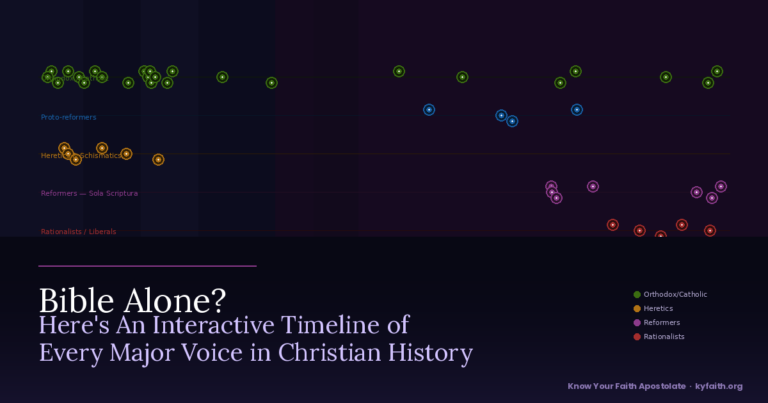
This is precisely what happened. But that story comes after the visual below.
Scripture & Tradition — Historical Survey
Scripture Alone as Sole Rule of Faith — Historical Survey
A visual history tracing every major voice from the Apostolic Fathers to the present. Tap any dot to see that figure’s position and a representative quote.
A note on terminology: All figures before the Great Schism of 1054 are identified as Catholic — because there was one undivided Church. “Protestant Innovators” is used deliberately: the 16th-century break introduced doctrinal novelty, principally Sola Scriptura, which no Church Father ever taught. “Modernist / Rationalist” reflects the Church’s own term for errors condemned by Pope St. Pius X in Pascendi Dominici Gregis (1907).
Note: Percentages are approximate, representing share of influential theological voices, not total Christian population.
What the Timeline Reveals
Look at what you have just seen. For fifteen centuries — fifteen — the overwhelming consensus of Christian theological thought, East and West, orthodox and careful, belongs to men and women who held Scripture and Tradition together as the twin sources of divine revelation, interpreted by the Church’s bishops in continuity with the Apostles. This is not a close call. This is not a matter of interpreting ambiguous evidence. The green lane of the orthodox is wide, deep, and continuous.
The heretics appear early and often, using Scripture against the Church. But they are always condemned. And here is what is essential to understand: the weapon the Church used against them was not more Scripture. It was Tradition. It was apostolic succession. It was the rule of faith. The Church said, in effect: you cannot read Scripture in isolation from the community that received it, preserved it, and has always understood it in this way.
The Reformation: New Doctrine, Not Recovered Truth
The Protestant Reformation of the sixteenth century is, by any historical measure, a rupture. Not a reform of existing doctrine but the introduction of a genuinely new one. Martin Luther, Ulrich Zwingli, and John Calvin did not recover Sola Scriptura from an ancient source — they invented it as a principle, drawing on certain strands of late medieval thought but going far beyond anything that had been said before.
Luther’s famous declaration at the Diet of Worms in 1521 — “My conscience is captive to the Word of God” — was electrifying. But it contained within it a fatal premise: that the individual conscience, armed with Scripture, is a higher authority than the Church’s councils, popes, and eighteen centuries of consistent interpretation. It is worth asking: on what authority does one make that claim? The answer cannot be Scripture, because Scripture does not teach Sola Scriptura. The claim must rest on something outside Scripture. Which is, precisely, the Catholic point.
“Scripture is self-authenticated… it is not right to subject it to proof and reasoning. The certainty it deserves with us it attains by the testimony of the Spirit.”
— John Calvin, Institutes of the Christian Religion, 1536
Calvin’s solution — that Scripture authenticates itself through the inner testimony of the Holy Spirit in each believer — sounds moving. But it offers no mechanism for resolving disagreement. If your inner testimony tells you one thing and mine tells me another, we have no court of appeal. And this is precisely what happened: within a generation of the Reformation, Protestantism had fractured into dozens of competing sects, each claiming the Spirit’s guidance and each reading Scripture differently.
The Catholic response was given definitively at the Council of Trent (1545–1563), which declared that Scripture and Tradition together, interpreted by the Church’s living Magisterium, constitute the rule of faith. Cardinal Robert Bellarmine, the great Jesuit theologian, spent years producing the most systematic refutation of Sola Scriptura ever written, demonstrating point by point that the principle could not be found in the Fathers, could not sustain itself logically, and was contradicted by Scripture itself.
The Internal Collapse: When Scripture-Alone Meets the Enlightenment
The timeline reveals something else, something that Protestant apologists rarely wish to discuss: the rationalist lane. Once the principle is established that the individual, relying on Scripture alone, is the ultimate judge of religious truth, nothing prevents the next generation from applying that same principle to Scripture itself.
Johann Semler, an eighteenth-century German Protestant theologian, did exactly that. Using the tools of historical criticism that Sola Scriptura had encouraged — the emphasis on private, rational investigation of texts — he concluded that Scripture was a historically conditioned human document, not a unified divine authority. Friedrich Schleiermacher reduced Christianity to an experience of religious feeling. Adolf von Harnack stripped away doctrine, councils, and creed until nothing remained but what he called ‘the simple Gospel of Jesus.’
These men were not attacking Christianity from outside. They were Protestants, working from within Protestant institutions, applying Protestant principles. The seed of Sola Scriptura, planted in the sixteenth century, had grown into the fruit of theological liberalism by the nineteenth. This is not a coincidence. It is a logical consequence.
“To be deep in history is to cease to be a Protestant.”
— Bl. John Henry Newman, An Essay on the Development of Christian Doctrine, 1845
Newman, who had been one of the most brilliant Anglican theologians of his generation, spent years studying the Fathers precisely to strengthen Protestantism’s historical claims. He found the opposite of what he was looking for. The deeper he went into history, the more clearly he saw that the Church of the Fathers was not Protestant. It was Catholic. In 1845, he was received into the Catholic Church, writing words that have echoed ever since.
What This Means for the Believer Today
The Catholic Church does not ask you to choose between Scripture and Tradition. That is a false choice — a choice manufactured by the Reformation and imported into our cultural air so thoroughly that many people cannot even imagine an alternative. The Church asks something far more demanding and far more beautiful: to receive the fullness of revelation as it has been given, in the living Word of God transmitted through Scripture AND Tradition, guarded and interpreted by the bishops in communion with the successor of Peter.
Scripture is not diminished by Tradition. It is protected by it. The canon of Scripture itself — the list of books you open every time you read your Bible — was determined not by Scripture but by Tradition, by the authority of the Church in the late fourth century. To accept the Bible while rejecting Tradition is, in a very real sense, to accept the Church’s authority with one hand while pushing it away with the other.
This is what the Fathers knew. This is what the martyrs died confessing. This is what fifteen centuries of Christian history, in both East and West, witness to with a unanimity that no other doctrine can match.
“The Bible itself testifies to the authority of Tradition and the Church. Sola Scriptura is the one tradition that Scripture itself refutes.”
— Dr. Scott Hahn, Catholic biblical theologian and former Presbyterian minister
The question is not whether you will have an authority outside yourself interpreting Scripture. You will. Everyone does. The question is whether that authority will be an individual pastor, a denomination founded four centuries ago, your own private judgment — or the Church that Christ Himself established, against which He promised the gates of hell would not prevail.
A Final Word
The interactive timeline you have just explored is not a polemic. It is a historical record. The figures on it — orthodox, heretical, reforming, liberal — are real people who lived, wrote, argued, and in many cases died for what they believed. Their words are their own.
What the timeline shows, with a clarity that is difficult to argue with, is that Sola Scriptura was unknown to the Church for its first fifteen centuries. Those who came closest to it were, in the Church’s own judgment, heretics. Those who formally proposed it as a principle were sixteenth-century innovators, not ancient recoverers. And those who took it to its logical conclusion dissolved not only Tradition but Scripture itself.
The Church has always known that the Living God does not leave His people without a living guide. Scripture is His Word. Tradition is its living memory. The Magisterium is its faithful guardian. These three are not rivals. They are one.
The devil is real. This is not a medieval superstition or a poetic metaphor. It is the consistent teaching of Scripture, of every pope, of every Doctor of the Church, and of every saint who has ever lived a serious life of faith. The enemy is real, he is active, and he is specifically interested in souls that are moving toward God.
This last point is important and often overlooked. Many people assume that if they are living a quiet, ordinary life, they are not a target for spiritual attack. But the truth is the opposite. The devil is least interested in souls already moving in his direction. It is the soul that prays, that receives the sacraments, that is genuinely trying to love God, that draws the most intense opposition.
“Satan especially hates those who love God fervently. From the moment you conceive a love for God, he tries to pollute it, with any worldly desire, foolishness, apathy, or pride he can slip in. We must be vigilant. Be sober and watchful, for your adversary the devil prowls around like a roaring lion, looking for someone to devour.”
The good news is that the Church has never left her children unarmed. Across two thousand years, the saints and the popes have given us prayers of tremendous power for exactly these moments. They are not magic formulas. They are acts of faith, confidence, and surrender to God, who alone has authority over every power of darkness.
Here are three of the most powerful prayers in the Catholic tradition for times of spiritual attack. Pray them with faith. Pray them without fear. The battle has already been won on the Cross. These prayers are how we claim that victory.
Prayer One: The Prayer to St. Michael the Archangel by Pope Leo XIII
Who wrote it and why it matters
On October 13, 1884, exactly thirty-three years before the Miracle of the Sun at Fatima, Pope Leo XIII had just finished celebrating Mass when he stopped suddenly and stood motionless for several minutes, his face drained of colour. Those present thought he had collapsed or died. When he came to himself, the Pope described a terrifying vision in which he had heard Satan boasting to God that he could destroy the Church if given enough time and power. Shortly afterward, Pope Leo XIII went to his study and wrote this prayer, ordering it to be recited after every Low Mass throughout the world.
Pope John Paul II later called on all Catholics to pray it. Pope Francis urged its recitation at the end of the Rosary. It remains one of the most powerful prayers of spiritual warfare in the entire Catholic tradition, and its power has not diminished with the centuries.
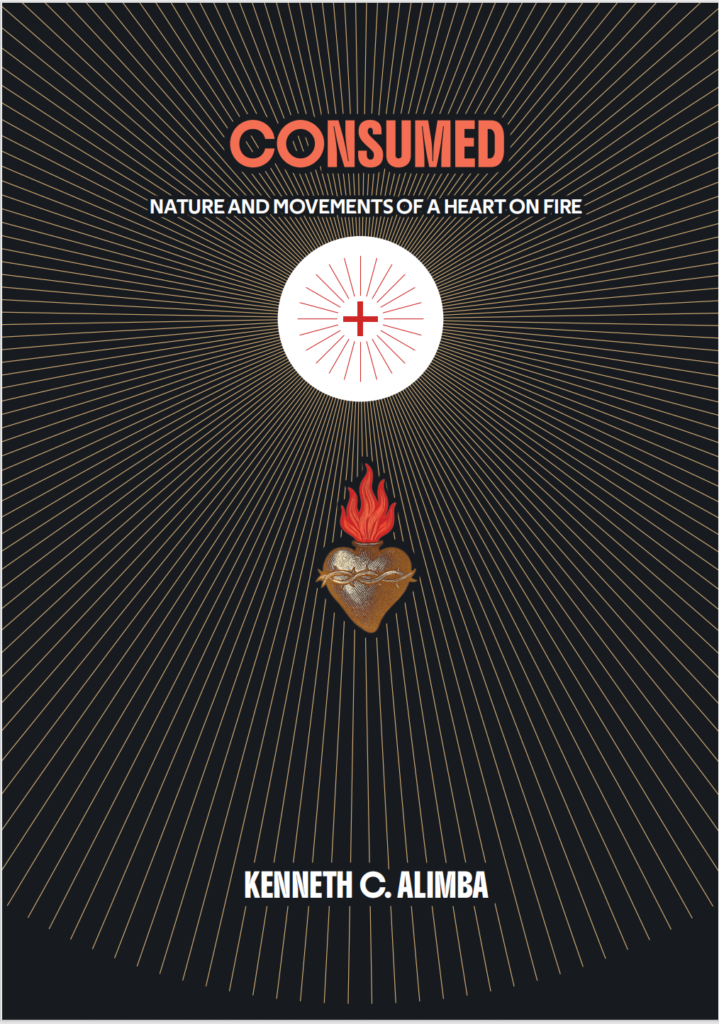
Consumed reminds us that the answer to every attack of the enemy is always the same:
“No matter what trick he tries, the answer is the same: run to Christ and hide in His Heart, acknowledging our weakness and poverty and helplessness without Him. Satan cannot hold the man who trusts completely in God.”
This prayer does exactly that. It runs to Christ through His great warrior archangel, and it does not flinch.
The Prayer
Saint Michael the Archangel, defend us in battle. Be our protection against the wickedness and snares of the devil. May God rebuke him, we humbly pray; And do thou, O Prince of the Heavenly Host, By the power of God, Cast into hell Satan and all the evil spirits Who prowl about the world seeking the ruin of souls. Amen.
For longer protection, the full prayer of Pope Leo XIII may be prayed as follows:
Most glorious Prince of the Heavenly Armies, Saint Michael the Archangel, defend us in our battle against principalities and powers, against the rulers of this world of darkness, against the spirits of wickedness in the high places.
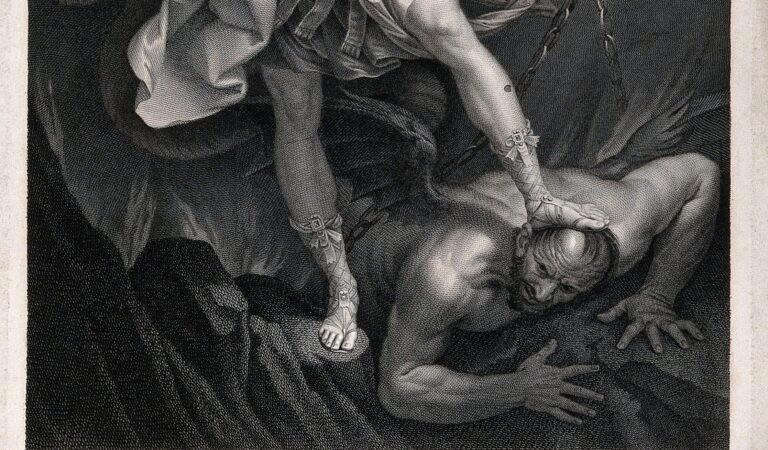
Come to the assistance of men whom God has created to His likeness and whom He has redeemed at a great price from the tyranny of the devil. Holy Church venerates thee as her guardian and protector; to thee, the Lord has entrusted the souls of the redeemed to be led into heaven. Pray therefore the God of Peace to crush Satan beneath our feet, that he may no longer retain men captive and do injury to the Church.
Offer our prayers to the Most High, that without delay they may draw His mercy down upon us; take hold of the dragon, the old serpent, which is the devil and Satan, bind him that he may no longer seduce the nations.
O God, the Father of our Lord Jesus Christ, we call upon Thy holy Name, and as supplicants we implore Thy clemency, that by the intercession of Mary, ever Virgin Immaculate and our Mother, and of the glorious Archangel Saint Michael, Thou wouldst deign to help us against Satan and all other unclean spirits who wander about the world for the injury of the human race and the ruin of souls. Amen.
Prayer Two: The Memorare, for Urgent Protection Through Our Lady
Who wrote it and why it matters
The Memorare is one of the oldest and most trusted Marian prayers in the Catholic tradition, dating to at least the fifteenth century. St. Francis de Sales relied on it daily and credited it with saving him from a severe spiritual crisis in his youth that brought him to the edge of despair. St. Teresa of Calcutta was known to pray it nine times in rapid succession when a need was urgent, calling it her “Flying Novena.”
What makes the Memorare so powerful as a prayer against spiritual attack is its confidence. It does not beg timidly. It makes a bold claim: that no one who has ever fled to Mary’s protection has been left unaided. That is an extraordinary promise, rooted in centuries of testimony from saints, sinners, and ordinary souls. It invokes Mary not as a distant figure but as a Mother, and it holds her to the promise that belongs to every mother who has ever held a frightened child.
In spiritual warfare, Mary is not a peripheral figure. She is the one of whom God said in Genesis that there would be enmity between her and the serpent, and that she would crush his head. The devil fears her in a way that exceeds his fear of almost any other creature, because she is the one human being who never gave him even the smallest foothold. When the attack is fierce, run to her.
The Prayer
Remember, O most gracious Virgin Mary, that never was it known that anyone who fled to thy protection, implored thy help, or sought thy intercession was left unaided.
Inspired by this confidence, I fly unto thee, O Virgin of virgins, my Mother. To thee do I come, before thee I stand, sinful and sorrowful. O Mother of the Word Incarnate, despise not my petitions, but in thy mercy hear and answer me. Amen.
Prayer Three: A Prayer Against Every Evil
Why this prayer matters
This prayer is one of the most comprehensive prayers of protection in the Catholic tradition for the use of the lay faithful. It invokes the entire power of God, the Blood of Christ, the Holy Spirit, Our Lady, the angels, and the saints against every form of spiritual attack, named and unnamed. It is a prayer that leaves nothing unaddressed and nothing uncovered.
It is particularly powerful for those who feel under sustained attack, whether through oppression, temptation, anxiety, spiritual dryness, or any sense of darkness they cannot shake. It is also prayed by many Catholic families as a daily protection for their households and their children.
Consumed reminds us of the one condition that makes any prayer of spiritual warfare effective:
“Submit yourselves therefore to God. Resist the devil, and he will flee from you. If we truly say, ‘Father, into Your hands I commit my spirit,’ in every aspect of life, what can the devil really do? If we have surrendered all, even our very self, to God, the devil finds no handle.”
Come to this prayer in that spirit of complete surrender to God, and pray it with confidence.
The Prayer
Heavenly Father, I love You, I praise You, and I worship You. I thank You for sending Your Son Jesus, who won victory over sin and death for my salvation. I thank You for sending Your Holy Spirit, who empowers me, guides me, and leads me into fullness of life. I thank You for Mary, my Heavenly Mother, who intercedes with the holy angels and saints for me.
Lord Jesus Christ, I place myself at the foot of Your Cross and ask You to cover me with Your Precious Blood, which pours forth from Your Most Sacred Heart and Your Most Holy Wounds. Cleanse me, my Jesus, in the living water that flows from Your Heart. Surround me, Lord Jesus, with Your holy light.
Spirit of our God, Father, Son, and Holy Spirit, Most Holy Trinity, descend upon me. Purify me, Lord; mold me, fill me with Yourself, use me. Banish all the forces of evil from me; destroy them, defeat them, so that I can be healthy and do good deeds.
Heavenly Father, allow Your Son Jesus to come now with the Holy Spirit, the Blessed Virgin Mary, the holy angels, and the saints to protect me from all harm and to keep all evil spirits from taking revenge on me in any way.
Lord Jesus, fill me with charity, compassion, faith, gentleness, hope, humility, joy, kindness, light, love, mercy, patience, peace, purity, trust, and wisdom. Help me to walk in Your Light and Truth, illuminated by the Holy Spirit, so that together we may praise, honor, and glorify our Father in time and in eternity.
For You, Lord Jesus, are the way, the truth, and the life. And You have come that we might have life, and have it more abundantly. Amen.
A Word on How to Use These Prayers
These three prayers work best when they flow from a life already rooted in the sacraments. No prayer of spiritual warfare is a substitute for Confession, for Holy Communion, for daily prayer, and for a genuine effort to remove from one’s life everything that gives the enemy a foothold. As Consumed puts it, if we have not abandoned all our unruly desires and accepted the yoke of Christ fully, the devil finds our loose ends. But if we abandon ourselves totally to God, there is nothing he can use against us.
Pray these prayers daily if you are under sustained attack. Pray them in the morning as a shield for the day. Pray them at night as a closing of all doors. Teach them to your children. Share them with anyone you know who is struggling in darkness.
The battle belongs to God. We are simply soldiers who have been taught to pray.
“Put on the whole armour of God, that you may be able to stand against the wiles of the devil.”
Have you experienced the power of these prayers in your own life? Share your testimony in the comments below, and pass this article on to someone who needs it today.
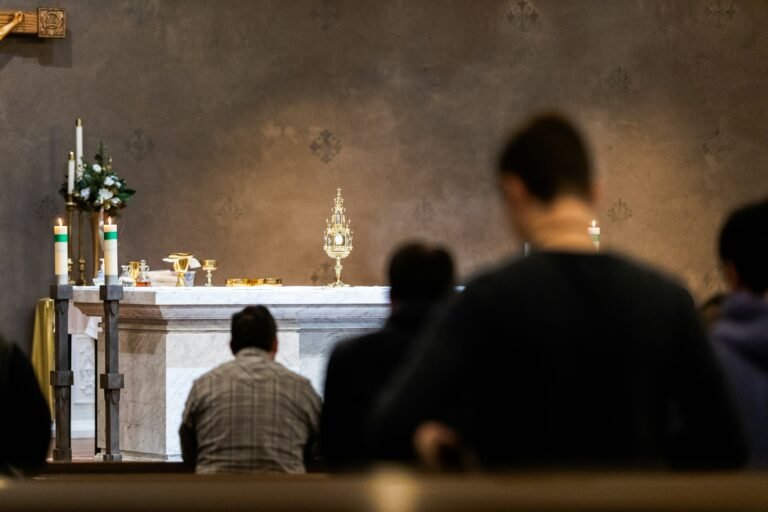
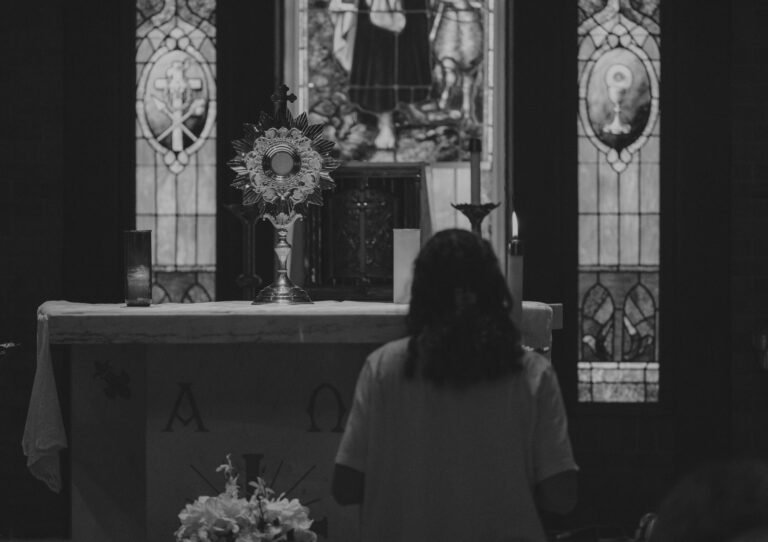
There is a place in every Catholic church where time bends. Where eternity presses against the ordinary world through a thin veil of bread. Where the God who made the universe waits, hidden and patient, for anyone willing to kneel.
That place is before the Blessed Sacrament.
Eucharistic Adoration is not a pious extra for especially devout Catholics. It is, as St. Alphonsus Liguori wrote, the greatest of all devotions after the sacraments themselves, the most pleasing to God and the most useful to our souls. The saints who understood this were transformed by it. St. Francis Xavier found his strength for the missions in nightly hours before the tabernacle. St. John Vianney spent entire nights there when the weight of souls became too heavy to carry alone. Mother Teresa built her entire apostolate to the poor on the foundation of one hour before the Blessed Sacrament each day.
Consumed describes what happens to a soul that genuinely discovers Christ in the Eucharist:
“The Eucharist becomes the sun of your life, drawing you to Himself, consuming you, transforming you into fire, and restoring order in the universe of your soul. Every vice melts away gradually. You submit to the excruciating torment that can come from being near the blazing fire, because it burns, but you also delight in the light and in the warmth of divine love.”
This is what Adoration is for. Not to fulfill an obligation. Not to appear devout. But to be transformed by the fire of a God who waits for you behind a veil, burning with love that has no end.
Below are seven of the most powerful prayers the Church’s saints have left us for time before the Blessed Sacrament. Use them as a guide for your holy hour, or choose one to anchor your entire time of prayer.
Prayer One: The Adoro Te Devote of St. Thomas Aquinas
Who wrote it and why it matters
St. Thomas Aquinas, the greatest theologian the Church has ever produced, composed this prayer for his own private adoration of the Blessed Sacrament. It was later incorporated into the public worship of the Church by Pope St. Pius V. Of all the Eucharistic prayers ever written, this is perhaps the most theologically profound. It confronts head-on the central mystery of the Eucharist: that our senses cannot detect what faith alone can grasp. Sight, touch, and taste are all deceived. Only the word of God, heard and believed, leads us to the truth hidden beneath the appearance of bread.
Pray it slowly, line by line. Let each verse open something in you.
The Prayer
O Godhead hid, devoutly I adore Thee, Who truly art within the forms before me; To Thee my heart I bow with bended knee, As failing quite in contemplating Thee.
Sight, touch, and taste in Thee are each deceived; The ear alone most safely is believed: I believe all the Son of God has spoken, Than truth’s own word there is no truer token.
God only on the Cross lay hid from view; But here lies hid at once the Manhood too: And I, in both professing my belief, Make the same prayer as the repentant thief.
Thy wounds, as Thomas saw, I do not see; Yet Thee confess my Lord and God to be: Make me believe Thee ever more and more; In Thee my hope, in Thee my love to store.
O thou Memorial of our Lord’s own dying! O Bread that living art and vivifying! Make ever Thou my soul on Thee to live; Ever a taste of Heavenly sweetness give.
O loving Pelican! O Jesu Lord! Unclean I am but cleanse me in Thy Blood; Of which a single drop, for sinners spilt, Can purge the entire world from all its guilt.
Jesu, whom for the present veiled I see, What I so thirst for, O vouchsafe to me: That I may see Thy countenance unfolding, And may be blest Thy glory in beholding. Amen.
Prayer Two: St. Alphonsus Liguori’s Visit to the Blessed Sacrament
Who wrote it and why it matters
St. Alphonsus Liguori wrote an entire book called Visits to the Most Blessed Sacrament, providing a prayer for every day of the month. This prayer, the most famous from that collection, has been prayed by millions across three centuries. Its opening image is one of the most striking in all Catholic devotional literature: Jesus remaining night and day in the tabernacle, full of pity and love, waiting, calling, welcoming all who come. He is not absent. He is not silent. He is there, right now, and He has been there all along.
The Prayer
My Lord Jesus Christ, for the love which Thou dost bear to men, Thou dost remain night and day in this Sacrament, full of compassion and of love, awaiting, calling and welcoming all who come to visit Thee.
I believe that Thou art present in the Sacrament of the Altar. I adore Thee from the abyss of my nothingness, and I thank Thee for all the graces which Thou hast bestowed upon me and in particular for having given me Thyself in this Sacrament, for having given me Thy Holy Mother Mary for my advocate, and for having called me to visit Thee in this church.
I now salute Thy most loving Heart, and this for three ends: first, in thanksgiving for this great gift; second, to make amends to Thee for all the outrages which Thou dost receive in this Sacrament from all Thine enemies; third, I intend by this visit to adore Thee in all the places on earth in which Thou art present in this Sacrament and in which Thou art the least revered and the most abandoned.
My Jesus, I love Thee with all my heart. I grieve for having so many times offended Thine infinite goodness. I promise, with Thy grace, never more to offend Thee in the future. Now, miserable and unworthy though I be, I consecrate myself to Thee without reserve; I give Thee my entire will, my affections, my desires, and all that I possess. From now on, do with me and with all that I have as Thou dost please.
All that I ask of Thee is Thy holy love, final perseverance, and the perfect accomplishment of Thy will. I recommend to Thee the souls in Purgatory, but especially those who had the greatest devotion to the Most Blessed Sacrament and to the Blessed Virgin Mary. I also recommend to Thee all poor sinners.
Finally, my dear Saviour, I unite all my desires with the desires of Thy most loving Heart; and I offer them, thus united, to the Eternal Father, and beseech Him in Thy name and for love of Thee to accept and grant them. Amen.
Prayer Three: The Anima Christi
Who wrote it and why it matters
This ancient prayer, beloved by St. Ignatius of Loyola and used for centuries before him, is as suited to Adoration as it is to thanksgiving after Communion. Before the Blessed Sacrament, it becomes a prayer of total immersion: the soul plunging itself into Christ, asking to be hidden in His wounds, defended by His Passion, and called by Him at the hour of death. It is a prayer that knows exactly where it is and exactly who it is kneeling before.
The Prayer
Soul of Christ, sanctify me. Body of Christ, save me. Blood of Christ, inebriate me. Water from the side of Christ, wash me. Passion of Christ, strengthen me. O good Jesus, hear me. Within Thy wounds hide me. Suffer me not to be separated from Thee. From the malignant enemy, defend me. In the hour of my death, call me. And bid me come to Thee. That with Thy saints I may praise Thee. Forever and ever. Amen.
Prayer Four: A Prayer of Reparation Before the Blessed Sacrament
Why this prayer matters
One of the deepest purposes of Adoration is reparation: making amends to Jesus for the indifference, irreverence, and outright hostility He receives in the Blessed Sacrament from those who do not believe, and even from those who do believe but receive Him carelessly. Consumed speaks of this directly when describing the right spirit for entering a church:
“When we enter the church with little to no thought as to the suffering it took to make this possible, then we are not being realistic. This lack of realism costs us greatly. We do not adequately reverence Christ or enter with great shock, gratitude, and awe at the gift of Christ to us.”
This prayer of reparation is an act of love on behalf of the whole Church and the whole world.
The Prayer
O most holy Trinity, Father, Son, and Holy Spirit, I adore Thee profoundly. I offer Thee the most precious Body, Blood, Soul, and Divinity of Jesus Christ, present in all the tabernacles of the world, in reparation for the outrages, sacrileges, and indifference with which He is offended.
By the infinite merits of the Sacred Heart of Jesus and the intercession of the Immaculate Heart of Mary, I beg the conversion of poor sinners.
O my Jesus, forgive us our sins, save us from the fires of hell, lead all souls to heaven, especially those in most need of Thy mercy. Amen.
Prayer Five: An Act of Spiritual Communion
Who wrote it and why it matters
When we cannot receive Jesus sacramentally during Adoration, we can receive Him spiritually. This prayer, written by St. Alphonsus Liguori, is one of the most beautiful expressions of desire for Christ in the entire Catholic tradition. It asks for what the heart of a lover always asks: not gifts, not graces, not consolations, but the Beloved Himself. As Consumed describes it, this is the mark of a soul that has truly understood the Eucharist:
“When someone forms an intimate relationship with Christ in the Eucharist, it is a beautiful and most distinctive sign of predestination. When they see this, they are filled with gratitude; when they receive Him, they are filled with love.”
My Jesus, I believe that You are present in the Most Holy Sacrament. I love You above all things, and I desire to receive You into my soul. Since I cannot at this moment receive You sacramentally, come at least spiritually into my heart.
I embrace You as if You were already there and unite myself wholly to You. Never permit me to be separated from You. Amen.
Prayer Six: O Sacrament Most Holy
Why this prayer matters
This short ejaculation has been prayed before the Blessed Sacrament for centuries and is one of the most widely used acclamations of Eucharistic devotion in the Catholic world. Its power lies precisely in its brevity. In the silence of Adoration, when words fail, this prayer carries the whole weight of faith, love, and gratitude in a single breath. Repeat it slowly. Let it become a rhythm that draws you deeper into the silence of His presence.
The Prayer
O Sacrament most holy, O Sacrament divine, All praise and all thanksgiving Be every moment Thine. Amen.
Prayer Seven: A Closing Prayer Before Leaving the Blessed Sacrament
Why this prayer matters
The hardest moment of Adoration is often the last one. When the hour is over and the world outside the church door rushes back in, there is a temptation to leave as though nothing has happened. This closing prayer, drawn from the tradition of Eucharistic devotion, is a way of carrying what happened in that holy hour out into the rest of the day. It acknowledges that we are being sent, not simply dismissed. That the fire kindled before the tabernacle is meant to burn in us as we go.
This is precisely what Consumed describes as the life of a soul on fire:
“You carry the fire of Christ within you, the Church’s mandate in your hands, and you speak with the voice of Christ to others. You are sent into the world by Christ, not so that you can become of the world, but so that you can be its light.”
Lord Jesus Christ, I thank You for this time in Your presence. I thank You for waiting for me, for welcoming me, for burning away what is false in me by the fire of Your love.
As I leave this place, let me not leave You behind. Come with me into my home, my work, my family, my conversations. Let whatever happened here between us be not forgotten by nightfall, but carried forward in every small act of love I manage to perform this day.
May the Sacred Heart of Jesus in the Most Blessed Sacrament be praised, adored, and loved with grateful affection, at every moment, in all the tabernacles of the world, even to the end of time. Amen.
Sweet Heart of Mary, be my salvation. Amen.
How to Make the Most of Your Time in Adoration
You do not need to pray all seven of these prayers in a single visit. One or two, prayed with full attention and genuine desire, will do more than seven prayed in a hurry.
Begin by kneeling and becoming still. Remind yourself of where you are and who is before you. Then choose a prayer and pray it slowly, pausing wherever a line strikes you. Let the pauses be as important as the words. God speaks most clearly in the silence between our sentences.
If your mind wanders, do not be troubled. Simply return. Every return to His presence, however small, is an act of love. And St. Alphonsus Liguori reminds us of what this time is worth:
“In a quarter of an hour’s prayer, spent in the presence of the Blessed Sacrament, you will perhaps gain more than in all the other spiritual exercises of the day.”
Begin with whatever time you have. Even fifteen minutes before the tabernacle, given with a willing heart, can change the direction of a soul.
“He who eats my flesh and drinks my blood abides in me, and I in him.”
Do you have a regular holy hour? Share how it has changed your life in the comments below, and pass this article on to someone who needs to spend more time with Jesus in the Blessed Sacrament.
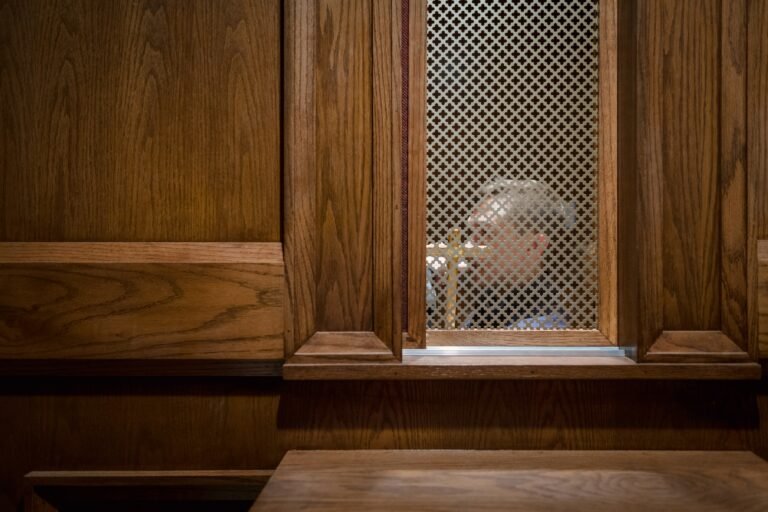
Of all the sacraments, Confession may be the most avoided and the most needed. Many Catholics go weeks, months, or even years without it, not because they do not believe in it, but because they dread it. The silence of the confessional. The weight of what they must say. The fear of the priest’s reaction. The shame of hearing their sins spoken out loud.
But here is what the saints knew that most of us forget: the fear you feel before Confession is not a sign that you should stay away. It is a sign that you should go. The enemy works hardest to keep us from the very sacrament that would undo his work in our souls.
St. Alphonsus Liguori, the Church’s great Doctor of moral theology and patron of confessors, wrote with absolute conviction:
“He who prays is certainly saved; he who does not pray is certainly damned.”
He could have said something similar about Confession. It is not a sacrament for perfect people. It is a sacrament for sinners. Which means it is for all of us, always.
Consumed is direct about what a soul looks like when it takes this sacrament seriously:
“If we ever have the misfortune of falling into mortal sin, we must repent immediately and run back to Christ. We should not let the fall trouble us to the point of robbing us of our peace. No, we must rise at once, knowing that we are still at war and there is no time to lie on the ground.”
The three prayers below are drawn from the deepest wells of the Catholic tradition. They are prayers to pray in the moments before you enter the confessional, to prepare your heart, open your conscience, and invite the Holy Spirit to show you what needs to be brought to the light. Pray them slowly. Pray them honestly. And then go.
Prayer One: To the Holy Spirit, for the Grace of a Good Confession
Why this prayer matters
Before we can confess well, we must first see clearly. And seeing clearly is not something we can do on our own. Our self-love is too strong, our blind spots too comfortable, our habits of self-justification too well practised. This is why the first prayer before Confession must always be addressed to the Holy Spirit, the one who searches all things, including the deep things of the soul, and who alone can show us what we have become.
This prayer has been used in the Catholic tradition for centuries, appearing in numerous prayer books and manuals for Confession. It asks for the one thing we cannot manufacture ourselves: the light to see the truth about our sins, and the grace to feel genuine sorrow for them rather than merely embarrassment at being caught.
Notice that it also asks to be freed from self-love, which is the greatest obstacle to a good Confession. We confess badly when we minimize, rationalize, or frame our sins in the most flattering possible light. The Holy Spirit cuts through all of that and shows us what God sees.
The Prayer
Come, Holy Spirit, into my soul.
Enlighten my mind that I may know the sins I ought to confess, and grant me Your grace to confess them fully, humbly, and with a contrite heart. Help me to firmly resolve not to commit them again.
O Blessed Virgin, Mother of my Redeemer, mirror of innocence and sanctity, and refuge of penitent sinners, intercede for me through the Passion of Your Son, that I may obtain the grace to make a good confession.
All you blessed Angels and Saints of God, pray for me, a most miserable sinner, that I may repent from my evil ways, that my heart may henceforth be forever united with yours in eternal love. Amen.
Prayer Two: Before Confession, by St. Alphonsus Liguori
Why this prayer matters
St. Alphonsus Liguori wrote more about Confession than almost any other saint in history. He understood its mechanics, its graces, its dangers, and its beauty with a depth that earned him the title of Doctor of the Church. He also suffered from scrupulosity himself for a period of his life, which gave him a pastoral gentleness for those who struggle to approach this sacrament with peace.
This prayer, written by St. Alphonsus as a preparation for Confession, is short but packed with everything a penitent soul needs: a request for Mary’s intercession, a plea for an examined conscience, genuine sorrow, and the grace to choose death over sin again. That last phrase, “beg for me the grace rather to die than to offend God again,” is not melodrama. It is the mark of a soul that has understood what sin actually costs.
Consumed captures this same spirit when it reflects on what genuine contrition looks like:
“Our contrition should be sorrowful in a way that lifts us up with hope because God is already near us, not sorrowful in a way that drags us down into despair. True contrition looks upward to God’s mercy; false contrition turns inward to hopelessness. The first makes us run back to the Father, the second only leaves us stranded in ourselves.”
St. Alphonsus’s prayer leads the soul precisely into this true contrition.
The Prayer
O my God, help me to make a good confession.
Mary, my dearest Mother, pray to Jesus for me. Help me to examine my conscience, enable me to obtain true sorrow for my sins, and beg for me the grace rather to die than to offend God again.
Lord Jesus, light of our souls, who enlightens every man coming into this world, enlighten my conscience and my heart by Thy Holy Spirit, so that I may perceive all that is displeasing to Thy divine majesty and may expiate it by humble confession, true contrition, and sincere repentance. Amen.
Prayer Three: Receive My Confession, O Lord Jesus Christ
Why this prayer matters
This ancient prayer from the Catholic tradition goes directly to the heart of what Confession is. It does not begin with our sins. It begins with Christ. It addresses Him as the “only hope for the salvation of my soul,” which is exactly the right disposition to carry into the confessional. We are not going to perform a religious ritual. We are not going to satisfy an obligation. We are going to the one Person in the universe who can actually do something about what we carry.
The prayer also asks for something that many Catholics never think to ask for before Confession: the light to know our sins. It is possible to enter the confessional with a genuine desire to confess and still confess badly, because we have not actually seen ourselves clearly. This prayer asks Christ to pierce through our defenses and show us what He sees, so that we may bring the full weight of it to His mercy and leave it there.
This is what Consumed calls running to God rather than away from Him:
“When we seek sacramental absolution, we take responsibility, receive healing, and continue the fight. Such a fall can actually remind us how fragile we are, and may indicate we had become prideful about our previous victories. So, we humble ourselves, re-apply ourselves to prayer with prudence and diligence, and ensure we do not lose any time.”
Receive my confession, O most loving and gracious Lord Jesus Christ, only hope for the salvation of my soul.
Grant to me true contrition of soul, so that day and night I may by penance make satisfaction for my many sins.
Savior of the world, O good Jesus, who gave Yourself to the death of the Cross to save sinners, look upon me, most wretched of all sinners; have pity on me, and give me the light to know my sins, true sorrow for them, and a firm purpose of never committing them again.
Permit me not to be blinded by self-love. Grant me, moreover, heartfelt sorrow for my transgressions, and the grace of a sincere confession, so that I may be forgiven and admitted into Your friendship. Amen.
After the Prayers: The Act of Contrition
Once you have prayed one or more of the prayers above, examined your conscience carefully, and entered the confessional, you will be asked to pray an Act of Contrition after confessing your sins and receiving your penance. This is the prayer the Church requires as the penitent’s formal expression of sorrow before the priest grants absolution. Here is the traditional form:
O my God, I am heartily sorry for having offended Thee, and I detest all my sins because I dread the loss of heaven and the pains of hell, but most of all because they offend Thee, my God, who art all good and deserving of all my love. I firmly resolve, with the help of Thy grace, to confess my sins, to do penance, and to amend my life. Amen.
A Final Word: Go Often
The saints did not treat Confession as an emergency measure for spiritual disaster. They treated it as a regular source of grace, healing, and strength. Pope Francis goes every two weeks. St. John Paul II went weekly. St. Pius X reportedly went even more frequently than that.
The Church’s minimum is once a year. But the saints knew that minimum was not the goal. The goal was a soul kept clean and close to God, regularly washed in the mercy of Christ, regularly restored to the friendship it was made for.
Do not wait until you are desperate. Go often. Go humbly. Go with these prayers on your lips and the whole weight of your need for God in your heart. He is waiting for you in that confessional with the same patience He has always had, the patience of a Father who never stops watching the road for his returning child.
“While he was yet at a distance, his father saw him and had compassion, and ran and embraced him and kissed him.”
When did you last go to Confession? Share your thoughts in the comments below, and pass this article on to someone who may need the encouragement to go.
Holy Communion is the most intimate moment a human soul can experience on this earth. You have just received the Body, Blood, Soul, and Divinity of Jesus Christ. He is inside you. He is present to you in a way that is real, personal, and overwhelming, if only we understood it fully.
And yet, for many of us, the minutes immediately after Communion are spent looking around, adjusting our clothes, thinking about what comes next after Mass. We receive the God of the universe and then, almost immediately, we move on.
The saints did not do this. They lingered. They wept. They were undone. St. Padre Pio once said that if we truly understood the Mass, we would die of joy. The moments after Communion are not an epilogue to the liturgy. They are perhaps its most sacred chapter, the moment when heaven and earth are most intimately joined in your very body.
Here is how Consumed describes what happens when a soul truly lives this reality:
“Each new day, your entire life is drawn toward Him again, the One whom you even dream of at night. And then, everywhere you are, you find yourself saying: Only three hours left before I can see my Jesus. The joy is like that of a bride awaiting her bridegroom, what delight, what holy anticipation!”
This is what receiving Jesus rightly does to a soul. It transforms time itself.
Below are three of the most powerful prayers the Church’s saints have left us for the moments after Holy Communion. Pray them slowly. Pray them from the heart. Let them do what they were written to do.
Prayer One: The Anima Christi
Who wrote it and why it matters
The Anima Christi, which means “Soul of Christ” in Latin, is one of the oldest and most beloved prayers in the Catholic tradition. Though sometimes attributed to St. Ignatius of Loyola, it predates him by at least a century, appearing in devotional texts as early as the fourteenth century. St. Ignatius loved it so much he placed it at the very beginning of his Spiritual Exercises, recommending it for use after Communion. It has been prayed by countless saints and souls across seven centuries.
What makes this prayer extraordinary is that it is not a prayer of thanksgiving from a distance. It is a prayer of total immersion. The soul throws itself into every aspect of Christ’s Passion and Person, asking to be hidden inside His wounds, to be washed by the water from His side, to be defended by His Passion. It is a prayer that understands what has just happened at the altar.
The Prayer
Soul of Christ, sanctify me. Body of Christ, save me. Blood of Christ, inebriate me. Water from the side of Christ, wash me. Passion of Christ, strengthen me. O good Jesus, hear me. Within Thy wounds hide me. Suffer me not to be separated from Thee. From the malignant enemy, defend me. In the hour of my death, call me. And bid me come to Thee. That with Thy saints I may praise Thee. Forever and ever. Amen.
Prayer Two: The Thanksgiving Prayer of St. Thomas Aquinas
Who wrote it and why it matters
St. Thomas Aquinas, the greatest theologian the Church has ever produced, was first and foremost a man of prayer. He once said that he had learned more by kneeling before the tabernacle than from all his books. This prayer of thanksgiving after Communion flows from that same spirit. It is a prayer of staggering humility from a man of staggering intelligence, which tells us something important: the closer we draw to God, the more clearly we see our own poverty before Him.
Notice how he describes himself as “a sinner” and “your unprofitable servant.” This is the Angelic Doctor speaking. If he prayed this way, so must we. The prayer also reaches forward into eternity, asking that this Communion be a foretaste of the heavenly banquet. That is exactly what the Eucharist is. As Consumed puts it:
“In Holy Communion, we receive a foretaste of heaven and are united to Christ. To be in heaven is to be in God, and in Holy Communion we receive a down payment of what shall be ours for all eternity.”
Lord, Father all-powerful and ever-living God, I thank You, for even though I am a sinner, Your unprofitable servant, not because of my worth but in the kindness of Your mercy, You have fed me with the Precious Body and Blood of Your Son, our Lord Jesus Christ.
I pray that this Holy Communion may not bring me condemnation and punishment but forgiveness and salvation. May it be a helmet of faith and a shield of good will. May it purify me from evil ways and put an end to my evil passions. May it bring me charity and patience, humility and obedience, and growth in the power to do good. May it be my strong defense against all my enemies, visible and invisible, and the perfect calming of all my evil impulses, bodily and spiritual. May it unite me more closely to You, the one true God, and lead me safely through death to everlasting happiness with You.
And I pray that You will lead me, a sinner, to the banquet where You, with Your Son and the Holy Spirit, are true and perfect light, total fulfillment, everlasting joy, gladness without end, and perfect happiness to Your saints. Grant this through Christ our Lord. Amen.
Prayer Three: The Stay With Me Lord Prayer of St. Padre Pio
Who wrote it and why it matters
St. Padre Pio of Pietrelcina spent hours in thanksgiving after each Mass. His Masses themselves could last several hours, because he lived so intensely what was happening on the altar that he could barely move through it. This prayer of his for after Communion captures the soul’s one great terror after receiving Jesus: that He might leave. That the warmth might fade. That the world would rush back in and crowd Him out.
The prayer asks for one thing above everything else: His presence. Not consolations. Not feelings. Not even spiritual gifts. Just Him. That is the mark of a soul that has truly learned to love. And it is what Consumed describes as the only worthy desire of a heart on fire:
“To love God also means to hunger for Him so that nothing can satisfy us unless we have God.”
Stay with me, Lord, for it is necessary to have You present so that I do not forget You. You know how easily I abandon You.
Stay with me, Lord, because I am weak and I need Your strength, that I may not fall so often.
Stay with me, Lord, for You are my life, and without You, I am without fervour.
Stay with me, Lord, for You are my light, and without You, I am in darkness.
Stay with me, Lord, to show me Your will.
Stay with me, Lord, so that I hear Your voice and follow You.
Stay with me, Lord, for I desire to love You very much, and always be in Your company.
Stay with me, Lord, if You wish me to be faithful to You.
Stay with me, Lord, for however poor my soul is, I wish it to be a place of consolation for You, a nest of love.
Stay with me, Jesus, for it is getting late and the day is coming to a close, and life passes; death, judgment, eternity approaches. It is necessary to renew my strength, so that I will not stop along the way and for that, I need You. It is getting late and death approaches; I fear the darkness, the temptations, the dryness, the cross, the sorrows. O how I need You, my Jesus, in this night of exile!
Stay with me tonight, Jesus, in life with all its dangers. I need You.
Let me recognize You as Your disciples did at the breaking of the bread, so that the Eucharistic Communion be the Light which disperses the darkness, the force which sustains me, the unique joy of my heart.
Stay with me, Lord, because at the hour of my death, I want to remain united to You, if not by Communion, at least by grace and love.
Stay with me, Jesus, I do not ask for divine consolation, because I do not merit it, but the gift of Your presence, oh yes, I ask this of You!
Stay with me, Lord, for it is You alone I look for, Your Love, Your Grace, Your Will, Your Heart, Your Spirit, because I love You and ask no other reward but to love You more and more.
With a firm love, I will love You with all my heart while on earth and continue to love You perfectly during all eternity. Amen.
A Final Word
These three prayers together form a complete act of thanksgiving after Communion. The Anima Christi grounds you in the reality of what has just happened. The prayer of St. Thomas Aquinas lifts your mind to what this Communion is leading you toward. And the prayer of St. Padre Pio holds you in that sacred moment, begging Jesus not to go.
You do not need to pray all three every time. Begin with one. Pray it slowly, line by line, meaning every word. Let it form you over weeks and months until your own heart begins to speak in the same language.
Because that is what these prayers are really for. Not to fill silence. Not to perform a devotion. But to train the heart to want what the saints wanted, until one day, like them, you find that the hours between Communions feel long, and the moment of receiving Him feels like coming home.
“He who eats my flesh and drinks my blood has eternal life, and I will raise him up at the last day.”
Do you have a favourite prayer you pray after Holy Communion? Share it in the comments below. And if this article helped you, consider sharing it with someone who loves the Eucharist.
Holy Communion is the most intimate moment a human soul can experience on this earth. You have just received the Body, Blood, Soul, and Divinity of Jesus Christ. He is inside you. He is present to you in a way that is real, personal, and overwhelming, if only we understood it fully.
And yet, for many of us, the minutes immediately after Communion are spent looking around, adjusting our clothes, thinking about what comes next after Mass. We receive the God of the universe and then, almost immediately, we move on.
The saints did not do this. They lingered. They wept. They were undone. St. Padre Pio once said that if we truly understood the Mass, we would die of joy. The moments after Communion are not an epilogue to the liturgy. They are perhaps its most sacred chapter, the moment when heaven and earth are most intimately joined in your very body.
Here is how Consumed describes what happens when a soul truly lives this reality:
“Each new day, your entire life is drawn toward Him again, the One whom you even dream of at night. And then, everywhere you are, you find yourself saying: Only three hours left before I can see my Jesus. The joy is like that of a bride awaiting her bridegroom, what delight, what holy anticipation!”
This is what receiving Jesus rightly does to a soul. It transforms time itself.
Below are three of the most powerful prayers the Church’s saints have left us for the moments after Holy Communion. Pray them slowly. Pray them from the heart. Let them do what they were written to do.
Prayer One: The Anima Christi
Who wrote it and why it matters
The Anima Christi, which means “Soul of Christ” in Latin, is one of the oldest and most beloved prayers in the Catholic tradition. Though sometimes attributed to St. Ignatius of Loyola, it predates him by at least a century, appearing in devotional texts as early as the fourteenth century. St. Ignatius loved it so much he placed it at the very beginning of his Spiritual Exercises, recommending it for use after Communion. It has been prayed by countless saints and souls across seven centuries.
What makes this prayer extraordinary is that it is not a prayer of thanksgiving from a distance. It is a prayer of total immersion. The soul throws itself into every aspect of Christ’s Passion and Person, asking to be hidden inside His wounds, to be washed by the water from His side, to be defended by His Passion. It is a prayer that understands what has just happened at the altar.
The Prayer
Soul of Christ, sanctify me. Body of Christ, save me. Blood of Christ, inebriate me. Water from the side of Christ, wash me. Passion of Christ, strengthen me. O good Jesus, hear me. Within Thy wounds hide me. Suffer me not to be separated from Thee. From the malignant enemy, defend me. In the hour of my death, call me. And bid me come to Thee. That with Thy saints I may praise Thee. Forever and ever. Amen.
Prayer Two: The Thanksgiving Prayer of St. Thomas Aquinas
Who wrote it and why it matters
St. Thomas Aquinas, the greatest theologian the Church has ever produced, was first and foremost a man of prayer. He once said that he had learned more by kneeling before the tabernacle than from all his books. This prayer of thanksgiving after Communion flows from that same spirit. It is a prayer of staggering humility from a man of staggering intelligence, which tells us something important: the closer we draw to God, the more clearly we see our own poverty before Him.
Notice how he describes himself as “a sinner” and “your unprofitable servant.” This is the Angelic Doctor speaking. If he prayed this way, so must we. The prayer also reaches forward into eternity, asking that this Communion be a foretaste of the heavenly banquet. That is exactly what the Eucharist is. As Consumed puts it:
“In Holy Communion, we receive a foretaste of heaven and are united to Christ. To be in heaven is to be in God, and in Holy Communion we receive a down payment of what shall be ours for all eternity.”
Lord, Father all-powerful and ever-living God, I thank You, for even though I am a sinner, Your unprofitable servant, not because of my worth but in the kindness of Your mercy, You have fed me with the Precious Body and Blood of Your Son, our Lord Jesus Christ.
I pray that this Holy Communion may not bring me condemnation and punishment but forgiveness and salvation. May it be a helmet of faith and a shield of good will. May it purify me from evil ways and put an end to my evil passions. May it bring me charity and patience, humility and obedience, and growth in the power to do good. May it be my strong defense against all my enemies, visible and invisible, and the perfect calming of all my evil impulses, bodily and spiritual. May it unite me more closely to You, the one true God, and lead me safely through death to everlasting happiness with You.
And I pray that You will lead me, a sinner, to the banquet where You, with Your Son and the Holy Spirit, are true and perfect light, total fulfillment, everlasting joy, gladness without end, and perfect happiness to Your saints. Grant this through Christ our Lord. Amen.
Prayer Three: The Stay With Me Lord Prayer of St. Padre Pio
Who wrote it and why it matters
St. Padre Pio of Pietrelcina spent hours in thanksgiving after each Mass. His Masses themselves could last several hours, because he lived so intensely what was happening on the altar that he could barely move through it. This prayer of his for after Communion captures the soul’s one great terror after receiving Jesus: that He might leave. That the warmth might fade. That the world would rush back in and crowd Him out.
The prayer asks for one thing above everything else: His presence. Not consolations. Not feelings. Not even spiritual gifts. Just Him. That is the mark of a soul that has truly learned to love. And it is what Consumed describes as the only worthy desire of a heart on fire:
“To love God also means to hunger for Him so that nothing can satisfy us unless we have God.”
Stay with me, Lord, for it is necessary to have You present so that I do not forget You. You know how easily I abandon You.
Stay with me, Lord, because I am weak and I need Your strength, that I may not fall so often.
Stay with me, Lord, for You are my life, and without You, I am without fervour.
Stay with me, Lord, for You are my light, and without You, I am in darkness.
Stay with me, Lord, to show me Your will.
Stay with me, Lord, so that I hear Your voice and follow You.
Stay with me, Lord, for I desire to love You very much, and always be in Your company.
Stay with me, Lord, if You wish me to be faithful to You.
Stay with me, Lord, for however poor my soul is, I wish it to be a place of consolation for You, a nest of love.
Stay with me, Jesus, for it is getting late and the day is coming to a close, and life passes; death, judgment, eternity approaches. It is necessary to renew my strength, so that I will not stop along the way and for that, I need You. It is getting late and death approaches; I fear the darkness, the temptations, the dryness, the cross, the sorrows. O how I need You, my Jesus, in this night of exile!
Stay with me tonight, Jesus, in life with all its dangers. I need You.
Let me recognize You as Your disciples did at the breaking of the bread, so that the Eucharistic Communion be the Light which disperses the darkness, the force which sustains me, the unique joy of my heart.
Stay with me, Lord, because at the hour of my death, I want to remain united to You, if not by Communion, at least by grace and love.
Stay with me, Jesus, I do not ask for divine consolation, because I do not merit it, but the gift of Your presence, oh yes, I ask this of You!
Stay with me, Lord, for it is You alone I look for, Your Love, Your Grace, Your Will, Your Heart, Your Spirit, because I love You and ask no other reward but to love You more and more.
With a firm love, I will love You with all my heart while on earth and continue to love You perfectly during all eternity. Amen.
A Final Word
These three prayers together form a complete act of thanksgiving after Communion. The Anima Christi grounds you in the reality of what has just happened. The prayer of St. Thomas Aquinas lifts your mind to what this Communion is leading you toward. And the prayer of St. Padre Pio holds you in that sacred moment, begging Jesus not to go.
You do not need to pray all three every time. Begin with one. Pray it slowly, line by line, meaning every word. Let it form you over weeks and months until your own heart begins to speak in the same language.
Because that is what these prayers are really for. Not to fill silence. Not to perform a devotion. But to train the heart to want what the saints wanted, until one day, like them, you find that the hours between Communions feel long, and the moment of receiving Him feels like coming home.
“He who eats my flesh and drinks my blood has eternal life, and I will raise him up at the last day.”
(John 6:54)
Do you have a favourite prayer you pray after Holy Communion? Share it in the comments below. And if this article helped you, consider sharing it with someone who loves the Eucharist.
There is a question every serious believer carries somewhere close to the surface: what does it actually take to make heaven? Not in the abstract. Not as theology. But as a life. As a daily, costly, joyful, relentless practice.
The saints answered this question not with words alone but with their entire existence. They left behind a road map written in blood, prayer, tears, and fire. What follows is that road map, drawn from their lives and from the wisdom of those who have walked seriously with God.
Rule One: Love God and Keep Your Eyes on Him
This is the first and the root of everything else. We must love God more than anything and desire, far above everything, to please Him. This desire to please God must be so consuming that nothing in creation compares to it. And if at the moment we do not have this burning desire, we must desire this desire and ask for it of God, who is always rich in mercy to bestow it upon us.
St. Clare of Assisi summarized it with a simplicity that cuts through every complication:
“Love God, serve God; everything is in that.”
But what does it mean to love God? It means giving Him not a portion but everything:
“If He has given us everything, we too must give everything. The only return for a life given is life itself; the only way to repay One who died for you is to die for Him. Life must be given for Life and death for death.”
This is the greatest bargain ever offered to a human soul. Everything we could ever give God is so far outweighed by what He gives in return that to hesitate even for a moment reveals how little we have truly understood what is being offered.
“I count everything as loss because of the surpassing worth of knowing Christ.”
(Philippians 3:8)
So we receive God and seek no other. And if we do seek other things, we seek them according to His law, in a manner that pleases Him.
Rule Two: Love Your Neighbour and Practise Charity and Mercy
The second rule flows directly from the first. We live out the consequence of loving God by directing that love toward our neighbours, loving them because of God rather than because of who they are or what they deserve.
When we love because of God, we do not love because of our neighbours. And when we do not love them for themselves alone, we can overlook their frailty and even their evils, and love them as God loves us and them. We love, in other words, with the very heart of God. We serve and show mercy even when it is not deserved, knowing that if we only love those who love us or those who have earned it, what value is it?
“If you love those who love you, what credit is that to you? Even sinners love those who love them.”
(Luke 6:32)
The saints understood that love shines brightest precisely when it is given to the undeserving:
“Some may object that God demands too much of us: asking us to bear injustice against our egos patiently, to forgive even the unrepentant who has not asked our pardon, to care for the needy, and to show love to the most undeserving, knowing that if they deserved it, it would be an act of justice, not love. But love shines brightest when it is given to the undeserving.”
Our objections about who deserves our mercy collapse entirely the moment we remember what we ourselves have received from God without deserving any of it.
Rule Three: Pray Without Ceasing
This rule is a direct consequence of the first. To love someone is to want to be with them. We cannot say we love God if we never desire to pray and commune with Him. Prayer is not merely a religious obligation. It is the breath of a soul that is alive in God.
“Prayer is to the soul what breathing is to the body. Cling to God in prayer and never let Him go.”
“A day without prayer should feel incomplete, because it is. Through prayer we dialogue with God and deepen His life in us, exchanging our death for His life, our hate for His love, our coldness for His fire.”
We must attend Mass weekly and, if possible, daily. There should be no limit to our desire for Christ in the Eucharist. It makes perfect sense to want Jesus more than once a day in communion, but far less sense to desire Him only once a week on Sunday. If Sunday is all we can manage, we must never feel dismayed. However, we must make daily acts of spiritual communion to keep alive this longing for our Lord in the Eucharist:
“The heart longs for Him at night and rejoices in the morning at Mass, when it possesses Him in Holy Communion, starting the day with such a burst of fire, gaining enough grace to carry out our tasks with love throughout the day. By midday the heart hungers for more, longing to spend a little time with Jesus in the Tabernacle, and counting the hours until it can receive Him again.”
This is far more coherent than forgetting Jesus after Sunday and not longing for Him again until the following week.
“Pray without ceasing.”
(1 Thessalonians 5:17)
Rule Four: Be Humble
Humility is difficult to attain for most of us because of our fallen nature. We are averse to service, to bearing insults and injuries patiently. We like to get even and exact some form of revenge. But humility is an invitation to live in the presence of God who loved us so radically that He gave Himself entirely for us.
The humility of God humbles all of us. At this point, no one can safely raise himself above his brother, since the Lord Himself made Himself subject to His own creatures for our sake. They beat Him, mocked Him, and killed Him. When confronted with this reality, we see that the love we have for our Lord compels us to be humble:
“We do not awake in awe because of our ingratitude in the face of such love from God, that He would endure our humanity to save us, and that this endurance was not enough: He chose to lay down His life, accepting the indignity of being killed naked on the Cross between two thieves by the very people whom He not only made, but at that very moment of His death continued to sustain in existence.”
This humility also compels us to submit to the Church wholeheartedly in matters of faith and morals, to follow her disciplines, and even when we disagree with pastoral judgements to still defer to her leaders with humility. No one comes to heaven without humility, and this humility begins with the genuine desire to be subject to all according to the will and pleasure of Almighty God.
St. Augustine captured the stakes with a single sentence:
“It was pride that changed angels into devils; it is humility that makes men as angels.”
And without this interior humility, even grace finds no way in:
“Without humility, Christ’s grace cannot take root in the soul; it remains unreceived, as oil on water.”
Rule Five: Practise Charity in Action, Not Just in Words
Go out into the world and make disciples. But also go out into the world and feed the hungry, clothe the naked, visit the sick, and stand with the forgotten. As St. Teresa of Avila wrote:
“Christ has no body now but yours, no hands, no feet on earth but yours. Yours are the eyes through which He looks with compassion on this world.”
The Mass itself commissions us for this. The sending forth at the end of the liturgy is not a dismissal but a mandate:
“You have your true life and being in the Church, the Body of Christ; you are sent from your home into the world, but without leaving your home. You are sent into the world by Christ, not so that you can become of the world, but so that you can be its light. You carry the fire of Christ within you, the Church’s mandate in your hands, and you speak with the voice of Christ to others.”
It is scandalous when those who know God and attend Mass week after week live lives no different from those who have never encountered Him:
“We who have eaten the Bread of life yet take bribes, refuse to pay just wages, and contribute to other social evils, and still count ourselves children of God, are fooling ourselves.”
“Faith by itself, if it does not have works, is dead.”
(James 2:17)
Rule Six: Fast and Train the Will
Many of the battles we fight against our fallen natures will be more quickly won and more firmly retained through fasting. We deprive the flesh of its comforts the better to learn detachment from created things, which is usually the source of many of our disorders and sins.
The saints taught without apology that fasting cleanses the soul, raises the mind, subjects the flesh to the spirit, and renders the heart contrite and humble. But this principle extends beyond food into every area where the senses must be governed:
“Guard your eyes against viewing things that incite lust or greed or anger. Guard your ears against gossip and unwholesome music. We must curb curiosity when it seeks to pry into others’ affairs. We avoid reading or watching things that glorify sin or ridicule virtue. In short, we strive to keep watch over what enters our mind through the senses.”
Fasting is not about food alone. It is about training the will to choose God over comfort, so that when temptation comes, there is something in us already accustomed to saying no.
“But I discipline my body and keep it under control, lest after preaching to others I myself should be disqualified.”
(1 Corinthians 9:27)
Rule Seven: Persevere Till the End
Whatever practice of faith we have will mean very little if in the end we abandon it. We must keep our end in view constantly and even meditate on death. One of the most powerful books for this kind of nightly meditation is Preparation for Death by St. Alphonsus Liguori. We must not only have our end in view, but constantly pray for the gift of final perseverance, so that we do not lose our faith at the last. God rewards only those who persevere to the end, even through many trials and tribulations.
For the soul who keeps falling and wonders whether to give up, the counsel is this:
“One thing you must remember is to keep peace of soul no matter what you have done. When we spiral after a sin, we are flirting with despair. The correct attitude is to maintain enough peace of soul to ask oneself critical questions: What do I need to do to avoid this sin in the future? What must I do to obtain pardon as quickly as possible, without wasting time?”
And for the soul who has fallen and risen and fallen again, this prayer points the way forward:
“Lord, I am sorry that I have foolishly fallen again. It seems all I can truly promise and keep is that I will never stop coming to You for mercy, and I will never stop fighting against my enemies, temptations, and sins. Have mercy and heal me.”
Perseverance is not the absence of falls. It is the refusal to stay down. Heaven is not for the perfect. It is for those who keep getting up.
“He who endures to the end will be saved.”
(Matthew 24:13)
And the most important reminder of all:
“You are made for God. Do not be afraid to give Him everything. Whatever you have comes from Him anyway, so give Him yourself as well. If you have no love for God, cry out for it. This is the one thing that makes life beautiful, the one thing that makes life worth living.”
O Lord, Jesus Christ, King of everlasting glory, behold I desire to come to you this day, and to receive your Body and Blood in this heavenly Sacrament, for your honor and glory, and the good of my soul. I desire to receive you, because it is your desire, and you have so willed it: blessed be your Name forever. I desire to come to you like Magdalen, that I may be delivered from all my evils, and embrace you, my only Good. I desire to come to you, that I may be happily united to you, that I may henceforth abide in you, and you in me; and that nothing in life or death may ever separate me from you. Amen.