
The Question That Divided the Christian West
There is a claim that has become so familiar in our time that many people assume it must have always existed — that it is, perhaps, the most natural thing in the world for a Christian to believe. The claim is this: that the Bible alone is the Christian’s sole and sufficient rule of faith; that every doctrine must be found explicitly in Scripture to be binding; that no council, no bishop, no tradition handed down through the centuries has any authority over the individual believer’s reading of the sacred text.
This teaching goes by its Latin name: Sola Scriptura — Scripture alone. It was the rallying cry of the Protestant Reformation in the sixteenth century, and it remains today the foundational principle of most Protestant denominations worldwide. For millions of sincere Christians, it is not even a doctrine to be defended but a self-evident truth: of course the Bible is our guide. What else could possibly stand alongside it?
But here is the question that Catholic apologists have always pressed, and that history forces us to take seriously: Was this ever the teaching of the Church? Not just of one century or one theologian, but of the living community of believers stretching from the Apostles to the present day — did that community ever hold that Scripture alone was sufficient, that Tradition was unnecessary, that bishops had no interpretive authority?
The answer, when you look at it honestly, is no. And the evidence for that answer is not hidden in some obscure Vatican archive. It is written in the words of the very men who built the Church, copied the Scriptures, died for the faith, and drove out the heretics — century by century, from Rome to Alexandria, from Antioch to Carthage, from Milan to Hippo.
What the Earliest Christians Actually Believed
When we speak of the Apostolic Fathers — the generation that sat at the feet of the Apostles or learned from those who did — we are speaking of men who had no reason to invent a doctrine. They simply passed on what they had received. And what they passed on was not a book handed to each believer to interpret privately. It was a living faith, embodied in a worshipping community, led by bishops who stood in an unbroken chain of authority from the Apostles themselves.
“Where the bishop appears, there let the people be; as where Jesus Christ is, there is the Catholic Church.”
— St. Ignatius of Antioch, Bishop and Martyr, † AD 107
Ignatius of Antioch wrote these words around the year 107 AD, while being transported to Rome for his martyrdom. He wrote to seven churches, and in every letter, the refrain is the same: cling to your bishop, cling to the Eucharist, cling to the Church. There is no suggestion — not the faintest whisper — that any individual Christian could or should pit his private reading of Scripture against the authoritative teaching of the bishop.
Papias of Hierapolis, who knew the Apostle John personally, went even further. He openly stated that he valued the living voice of apostolic tradition above written texts. For him, the community of memory — the words passed from teacher to disciple, from bishop to bishop — was not inferior to Scripture but its necessary companion and guardian.
By the end of the second century, Irenaeus of Lyon had given this understanding its most systematic expression. Facing the Gnostic heretics of his day — men who, remarkably, used exactly the same argument that later Reformers would use, claiming that private scripture and secret knowledge trumped the Church’s teaching — Irenaeus struck back with the full force of historical argument.
“The tradition of the apostles, made manifest in all the world, can be clearly seen in every Church by those who wish to behold the truth, and we are in a position to reckon up those who were by the apostles instituted bishops in the Churches, and the succession of these men to our own times.”
— St. Irenaeus of Lyon, Bishop, c. AD 185
This is not the language of a man who thought Scripture was self-sufficient. This is the language of a man who knew that Scripture and Tradition and episcopal succession were three interlocking pillars of the same structure, and that to remove any one of them was to bring the whole edifice down.
The Heretics Got There First
Here is something that should give every sincere Protestant serious pause: the first people in Christian history to pit Scripture against the Church’s authority were not reformers. They were heretics.
Marcion of Sinope, excommunicated around AD 144, rejected the Old Testament entirely and produced his own edited version of the New Testament. He did not do this randomly. He had a theological agenda, and he used selective scripture to pursue it against the teaching of the bishops. Marcion is often called the first biblical canon-maker — but the Church looked at what he had done and recoiled.
Arius, in the fourth century, used Scripture texts to argue against the divinity of Christ — against the very teaching that the Church had received from the Apostles and that the bishops assembled at Nicaea in 325 AD were defending. He had his proof-texts. The Church had its Tradition. The Council of Nicaea declared Tradition the winner.
This pattern repeats, century after century, with a remarkable consistency: the heretic isolates certain passages of Scripture, reads them apart from the Church’s living Tradition, and arrives at a conclusion that contradicts what the community of faith had always believed. And the Church’s response, always, is not to produce more Scripture but to invoke the apostolic deposit — what has been believed everywhere, always, by all, as St. Vincent of Lérins would formulate it in the fifth century.
“In the Catholic Church herself, all possible care must be taken, that we hold that faith which has been believed everywhere, always, by all.”
— St. Vincent of Lérins, c. AD 434 — the famous Vincentian Canon
The Great Doctors Speak With One Voice
It would take many volumes to quote every major Father and Doctor of the Church on this question. What is striking is not that they disagree with Sola Scriptura — they all do — but that they do so in such varied and rich ways, as though approaching the same truth from different angles.
Basil the Great, one of the most rigorous biblical scholars the Church has ever produced, was explicit that apostolic tradition transmitted both in writing and orally carries equal authority. Augustine of Hippo, perhaps the most influential theologian in Western history, famously declared that he would not believe the Gospel itself if the authority of the Catholic Church had not moved him — not because Scripture is untrustworthy, but because it is the Church that establishes, authenticates, and hands on the canon.
Thomas Aquinas, writing in the thirteenth century, affirmed Scripture as the supreme rule of faith but was equally clear that it requires the Church as its living interpreter. Without that interpreter, Scripture becomes a battlefield where every faction claims it as its own weapon.
This is precisely what happened. But that story comes after the visual below.
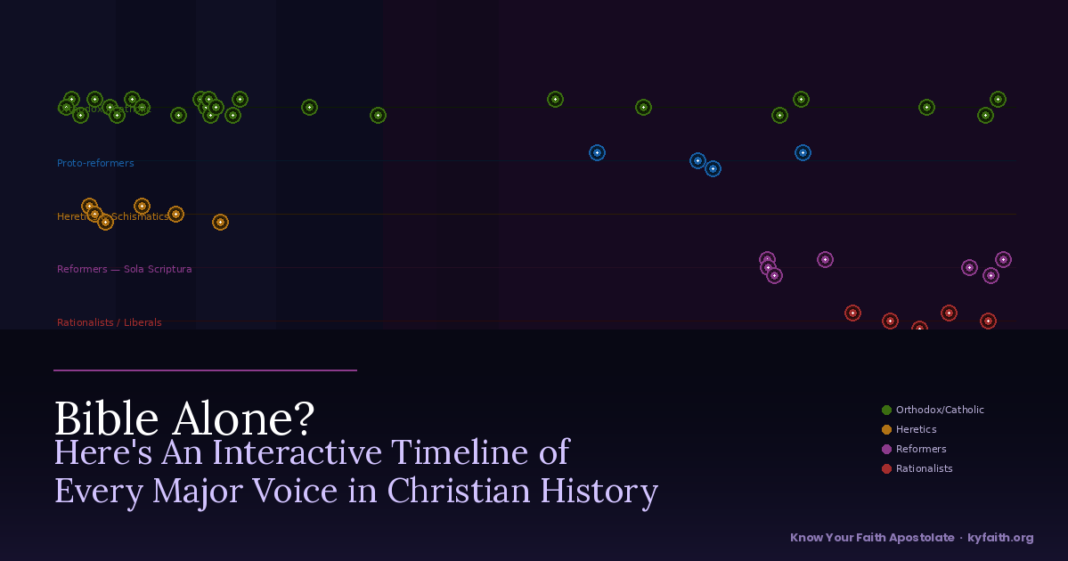
Scripture Alone as Sole Rule of Faith — Historical Survey
A visual history tracing every major voice from the Apostolic Fathers to the present. Tap any dot to see that figure’s position and a representative quote.
A note on terminology: All figures before the Great Schism of 1054 are identified as Catholic — because there was one undivided Church. “Protestant Innovators” is used deliberately: the 16th-century break introduced doctrinal novelty, principally Sola Scriptura, which no Church Father ever taught. “Modernist / Rationalist” reflects the Church’s own term for errors condemned by Pope St. Pius X in Pascendi Dominici Gregis (1907).
← Scroll left & right to explore the full timeline →
What the Timeline Reveals
Look at what you have just seen. For fifteen centuries — fifteen — the overwhelming consensus of Christian theological thought, East and West, orthodox and careful, belongs to men and women who held Scripture and Tradition together as the twin sources of divine revelation, interpreted by the Church’s bishops in continuity with the Apostles. This is not a close call. This is not a matter of interpreting ambiguous evidence. The green lane of the orthodox is wide, deep, and continuous.
The heretics appear early and often, using Scripture against the Church. But they are always condemned. And here is what is essential to understand: the weapon the Church used against them was not more Scripture. It was Tradition. It was apostolic succession. It was the rule of faith. The Church said, in effect: you cannot read Scripture in isolation from the community that received it, preserved it, and has always understood it in this way.
The Reformation: New Doctrine, Not Recovered Truth
The Protestant Reformation of the sixteenth century is, by any historical measure, a rupture. Not a reform of existing doctrine but the introduction of a genuinely new one. Martin Luther, Ulrich Zwingli, and John Calvin did not recover Sola Scriptura from an ancient source — they invented it as a principle, drawing on certain strands of late medieval thought but going far beyond anything that had been said before.
Luther’s famous declaration at the Diet of Worms in 1521 — “My conscience is captive to the Word of God” — was electrifying. But it contained within it a fatal premise: that the individual conscience, armed with Scripture, is a higher authority than the Church’s councils, popes, and eighteen centuries of consistent interpretation. It is worth asking: on what authority does one make that claim? The answer cannot be Scripture, because Scripture does not teach Sola Scriptura. The claim must rest on something outside Scripture. Which is, precisely, the Catholic point.
“Scripture is self-authenticated… it is not right to subject it to proof and reasoning. The certainty it deserves with us it attains by the testimony of the Spirit.”
— John Calvin, Institutes of the Christian Religion, 1536
Calvin’s solution — that Scripture authenticates itself through the inner testimony of the Holy Spirit in each believer — sounds moving. But it offers no mechanism for resolving disagreement. If your inner testimony tells you one thing and mine tells me another, we have no court of appeal. And this is precisely what happened: within a generation of the Reformation, Protestantism had fractured into dozens of competing sects, each claiming the Spirit’s guidance and each reading Scripture differently.
The Catholic response was given definitively at the Council of Trent (1545–1563), which declared that Scripture and Tradition together, interpreted by the Church’s living Magisterium, constitute the rule of faith. Cardinal Robert Bellarmine, the great Jesuit theologian, spent years producing the most systematic refutation of Sola Scriptura ever written, demonstrating point by point that the principle could not be found in the Fathers, could not sustain itself logically, and was contradicted by Scripture itself.
The Internal Collapse: When Scripture-Alone Meets the Enlightenment
The timeline reveals something else, something that Protestant apologists rarely wish to discuss: the rationalist lane. Once the principle is established that the individual, relying on Scripture alone, is the ultimate judge of religious truth, nothing prevents the next generation from applying that same principle to Scripture itself.
Johann Semler, an eighteenth-century German Protestant theologian, did exactly that. Using the tools of historical criticism that Sola Scriptura had encouraged — the emphasis on private, rational investigation of texts — he concluded that Scripture was a historically conditioned human document, not a unified divine authority. Friedrich Schleiermacher reduced Christianity to an experience of religious feeling. Adolf von Harnack stripped away doctrine, councils, and creed until nothing remained but what he called ‘the simple Gospel of Jesus.’
These men were not attacking Christianity from outside. They were Protestants, working from within Protestant institutions, applying Protestant principles. The seed of Sola Scriptura, planted in the sixteenth century, had grown into the fruit of theological liberalism by the nineteenth. This is not a coincidence. It is a logical consequence.
“To be deep in history is to cease to be a Protestant.”
— Bl. John Henry Newman, An Essay on the Development of Christian Doctrine, 1845
Newman, who had been one of the most brilliant Anglican theologians of his generation, spent years studying the Fathers precisely to strengthen Protestantism’s historical claims. He found the opposite of what he was looking for. The deeper he went into history, the more clearly he saw that the Church of the Fathers was not Protestant. It was Catholic. In 1845, he was received into the Catholic Church, writing words that have echoed ever since.
What This Means for the Believer Today
The Catholic Church does not ask you to choose between Scripture and Tradition. That is a false choice — a choice manufactured by the Reformation and imported into our cultural air so thoroughly that many people cannot even imagine an alternative. The Church asks something far more demanding and far more beautiful: to receive the fullness of revelation as it has been given, in the living Word of God transmitted through Scripture AND Tradition, guarded and interpreted by the bishops in communion with the successor of Peter.
Scripture is not diminished by Tradition. It is protected by it. The canon of Scripture itself — the list of books you open every time you read your Bible — was determined not by Scripture but by Tradition, by the authority of the Church in the late fourth century. To accept the Bible while rejecting Tradition is, in a very real sense, to accept the Church’s authority with one hand while pushing it away with the other.
This is what the Fathers knew. This is what the martyrs died confessing. This is what fifteen centuries of Christian history, in both East and West, witness to with a unanimity that no other doctrine can match.
“The Bible itself testifies to the authority of Tradition and the Church. Sola Scriptura is the one tradition that Scripture itself refutes.”
— Dr. Scott Hahn, Catholic biblical theologian and former Presbyterian minister
The question is not whether you will have an authority outside yourself interpreting Scripture. You will. Everyone does. The question is whether that authority will be an individual pastor, a denomination founded four centuries ago, your own private judgment — or the Church that Christ Himself established, against which He promised the gates of hell would not prevail.
A Final Word
The interactive timeline you have just explored is not a polemic. It is a historical record. The figures on it — orthodox, heretical, reforming, liberal — are real people who lived, wrote, argued, and in many cases died for what they believed. Their words are their own.
What the timeline shows, with a clarity that is difficult to argue with, is that Sola Scriptura was unknown to the Church for its first fifteen centuries. Those who came closest to it were, in the Church’s own judgment, heretics. Those who formally proposed it as a principle were sixteenth-century innovators, not ancient recoverers. And those who took it to its logical conclusion dissolved not only Tradition but Scripture itself.
The Church has always known that the Living God does not leave His people without a living guide. Scripture is His Word. Tradition is its living memory. The Magisterium is its faithful guardian. These three are not rivals. They are one.
Make a one-time donation
Make a monthly donation
Make a yearly donation
Choose an amount
Or enter a custom amount
Your contribution is appreciated.
Your contribution is appreciated.
Your contribution is appreciated.
DonateDonate monthlyDonate yearlyDiscover more from Catholicsay
Subscribe to get the latest posts sent to your email.