Friday, April 3, 2026
12.4 C
London
Home Blog Page 178

Prayer to Saint Joseph in Time of Need

Who is Saint Joseph?


Everything we know about the husband of Mary and the foster father of Jesus comes from Scripture and that has seemed too little for those who made up legends about him.

We know he was a carpenter, a working man, for the skeptical Nazarenes ask about Jesus, “Is this not the carpenter’s son?” (Matthew 13:55). He wasn’t rich for when he took Jesus to the Temple to be circumcised and Mary to be purified he offered the sacrifice of two turtledoves or a pair of pigeons, allowed only for those who could not afford a lamb (Luke 2:24).

Despite his humble work and means, Joseph came from a royal lineage. Luke and Matthew disagree some about the details of Joseph’s genealogy but they both mark his descent from David, the greatest king of Israel (Matthew 1:1-16 and Luke 3:23-38). Indeed the angel who first tells Joseph about Jesus greets him as “son of David,” a royal title used also for Jesus.

We know Joseph was a compassionate, caring man. When he discovered Mary was pregnant after they had been betrothed, he knew the child was not his but was as yet unaware that she was carrying the Son of God. He knew women accused of adultery could be stoned to death, so he resolved to send her away quietly to not expose her to shame or cruelty. However, when an angel came to Joseph in a dream and told him, 20 “Joseph son of David, do not be afraid to take Mary home as your wife, because what is conceived in her is from the Holy Spirit. 21 She will give birth to a son, and you are to give him the name Jesus, because he will save his people from their sins,” he did as the angel told him and took Mary as his wife. (Matthew 1:19-25).

When the angel came again to tell him that his family was in danger, he immediately left everything he owned, all his family and friends, and fled to a strange country with his young wife and the baby. He waited in Egypt without question until the angel told him it was safe to go back (Matthew 2:13-23).

We know Joseph loved Jesus. His one concern was for the safety of this child entrusted to him. Not only did he leave his home to protect Jesus, but upon his return settled in the obscure town of Nazareth out of fear for his life. When Jesus stayed in the Temple we are told Joseph (along with Mary) searched with great anxiety for three days for him (Luke 2:48). We also know that Joseph treated Jesus as his own son for over and over the people of Nazareth say of Jesus, “Is this not the son of Joseph?” (Luke 4:22)

We know Joseph respected God. He followed God’s commands in handling the situation with Mary and going to Jerusalem to have Jesus circumcised and Mary purified after Jesus’ birth. We are told that he took his family to Jerusalem every year for Passover, something that could not have been easy for a working man.

Since Joseph does not appear in Jesus’ public life, at his death, or resurrection, many historians believe Joseph probably had died before Jesus entered public ministry.

According to the Catholic Encyclopedia, the Apocryphal Date for Joseph’s birth is 90 BC in Bethlehem and the Apocryphal Date of his death is July 20, AD 18 in Nazareth.

Joseph is the patron saint of the dying because, assuming he died before Jesus’ public life, he died with Jesus and Mary close to him, the way we all would like to leave this earth.

Joseph is also patron saint of the Universal Church, families, fathers, expectant mothers (pregnant women), travelers, immigrants, house sellers and buyers, craftsmen, engineers, and working people in general.

We celebrate two feast days for Joseph: March 19 for Joseph the Husband of Mary and May 1 for Joseph the Worker. March 19 has been the most commonly celebrated feast day for Joseph, and it wasn’t until 1955 that Pope Pius XII established the Feast of “St. Joseph the Worker” to be celebrated on May 1. This is also May Day (International Workers’ Day) and believed to reflect Joseph’s status as the patron of workers.

Many places and churches all over the world are named after St. Joseph, including the Spanish form, San Jose, which is the most commonly named place in the world. Joseph is considered by many to also be the patron saint of the New World; of the countries China, Canada, Korea, Mexico, Austria, Belgium, Croatia, Peru, Vietnam; of the regions Carinthia, Styria, Tyrol, Sicily; and of several main cities and dioceses.

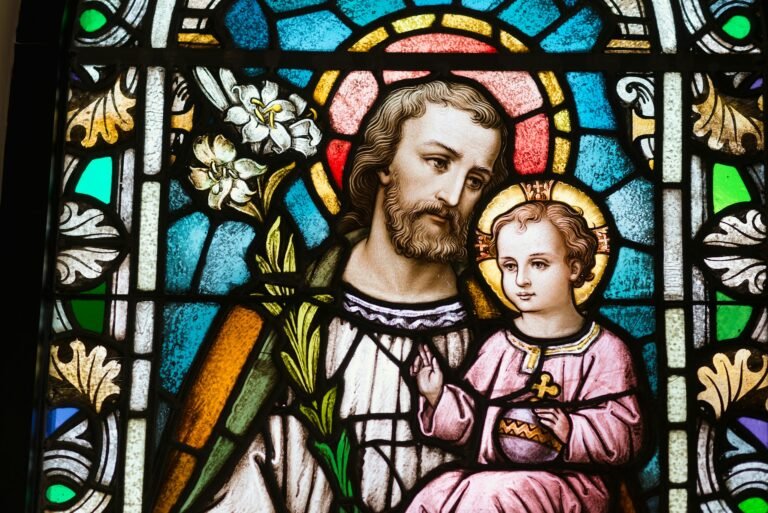
In art, Joseph is typically portrayed as an older man, with grey hair and a beard, often balding, sometimes appearing frail and a marginal figure next to Mary and Jesus, if not entirely in the background. Some statues of Joseph show his staff topped with flowers. St. Joseph is shown with the attributes of a carpenter’s square or tools, the infant Jesus, his lily blossomed staff, two turtle doves, or a spikenard.

There is much we still wish we could know about Joseph — exactly where and when he was born, how he spent his days, exactly when and how he died. But Scripture has left us with the most important knowledge: who he was — “a righteous man” (Matthew 1:18).

In His Footsteps:

Joseph was foster father to Jesus. There are many children separated from families and parents who need foster parents. Please consider contacting your local Catholic Charities or Division of Family Services about becoming a foster parent.

PRAYER

To you, O blessed Joseph, do we fly in our tribulation, and having implored the help

of your most holy Spouse, we confidently invoke your patronage also. Through that

charity which bound you to the Immaculate Virgin Mother of God, and braced the

Child Jesus, we humbly beseech you graciously to regard the inheritance which

Jesus Christ has purchased by His Blood, and with your power and strength to aid us

in our necessities.


O most watchful Guardian of the Holy Family, defend the chosen children of Jesus

Christ; O most loving father, ward off from us every contagion of error and

corrupting influence; O our most mighty protector, be propitious to us and from

heaven assist us in this our struggle with the power of darkness; and, as one you

rescued the Child Jesus from deadly peril, so now protect God’s Holy Church from

the snares of the enemy and from all adversity; shield, too, each one of us by your

constant protection, so that, supported by your example and your aid, we may be

able to live piously, and to die holily, and to obtain eternal happiness in heaven. Amen.

Prayer to Saint Anthony, Performer of Miracles

Dear St. Anthony, your prayers obtained miracles during your lifetime. You still seem to move at ease in the realm of minor and major miracles. St. Anthony, Performer of Miracles, please obtain for me the blessings God holds in reserve who serve Him. Pray that I may be worthy of the promises my Lord Jesus attaches to confident prayer.

(Mention your special intentions.)

St. Anthony, gentlest of Saints, your love for God and charity for his creatures, made you worthy, when on earth, to possess miraculous powers. Miracles waited on your word, which you were ready to speak for those in trouble or anxiety. Encouraged by this thought, I ask you to obtain for me the favors that I seek.

The answer to my prayer may require a miracle, even so, you are the Saint of Miracles.

O gentle and loving St. Anthony, whose heart was full of sympathy, whisper my petition into the ears of the Infant Jesus, who loved to be held in your arms; and the gratitude of my heart will ever be yours. Amen.

Act of Dedication to the Blessed Virgin

My Queen and my Mother,

I give myself entirely to you

and in proof of my affection,

I give you my eyes, my ears,

my tongue, my heart,

my whole being without reserve.

Since I am your own,

keep me and guard me as your property and possession.

Amen.

A SHORT PRAYER FOR A CURE

Gentle Jesus,

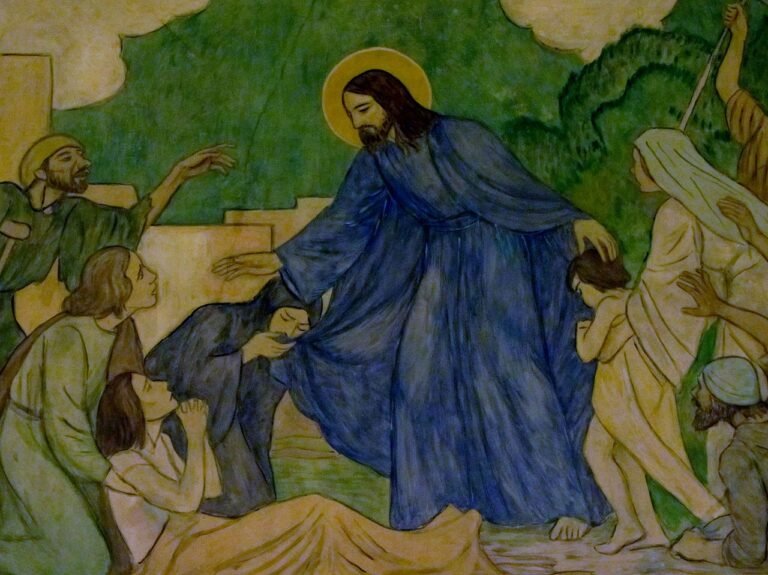
who cured the sick and laid a healing hand upon the lame,

the blind and the handicapped,

look with compassion upon me in my suffering.

If it is not your Will to cure me,

then give me strength to bear my burden and offer it up to You.

You suffered so much for me.

Give me grace to offer my sufferings in union with Your own,

in reparation for my sins and those of others,

for the needs of this troubled world,

and for the release of the souls in purgatory.

Mary, compassionate Mother, pray for your weary child.

Health of the Sick, Comforter of the Afflicted,

pray for me. Amen.

Need a taste of Heaven and a shot of joy? Try the very short Easter prayer.

0

Dating back to the 6th century, tradition says this prayer was created with the dialogue of an angel and a pope.

The Regina Caeli (Latin for “Queen of Heaven”) is offered us by the Church as a hallmark of Easter. Lasting for a full 50 days, Easter is a very long season — 10 days longer than Lent. The Regina Caeli is integrated especially into two daily Catholic devotions.

First, in the Divine Office prayed by priests, religious and many laypeople, the Regina Caeli is the Easter season Marian antiphon at the end of Night Prayer.

Then, the Church replaces during Easter the daily Angelus prayer with the Regina Caeli, traditionally prayed thrice daily (at 6:00 a.m., noon, and 6:00 p.m).

The Angelus/Regina Caeli is prayed publicly by the pope and pilgrims in St. Peter’s Square on most Sundays. The pope offers a short greeting (usually with a reflection on the day’s readings) before leading the people in the prayer.

According to legend, this prayer dates back to the sixth century with Pope Gregory the Great. As the story goes, when the city of Rome was plagued with an epidemic, St. Gregory led a procession out from St. Peter’s Basilica past the Mausoleum of Hadrian in prayerful petition to end the plague.

Then, on top of the mausoleum, he saw an angel singing the words of the Regina Caeli. He responded in words also in the prayer, “Ora pro nobis Deum, alleluia!” or “Pray for us to God, alleluia!”

Inspired by this event, the faithful henceforth referred to the mausoleum with a different name: Castel Sant’Angelo (Castle of the Holy Angel) and the nearby bridge became known as the Ponte Sant’Angelo (Bridge of Angels).

The Church in Rome received two gifts that day. The disease of the city was cured and a new prayer was established to help remind the faithful of joy even in times of great suffering.

What, specifically, do we meditate on in this prayer?

First, the prayer assures us that Jesus truly is risen. This reflects the journey that all the disciples had to undertake, encountering the Risen Christ and thus leaving behind their doubt to become Christ’s witnesses.

Second, the prayer reminds us what the season of Easter is all about. We offer joyful praise to God with the word “alleluia” six separate times. Also, we proclaim different variations of the word “joy” five times (rejoice, rejoice, glad, joy, joys).

The Regina Caeli reminds us of the Resurrection and the meaning that it has for our lives. The Lord is risen and we can share in Easter joy with Mary, the Queen of Heaven. We can truly proclaim “alleluia,” giving praise to God for the great gift of everlasting life he offers us.

We need help on this journey to heaven. So we turn to Mary, the humble handmaid of the Lord whose openness to the will of God led to her coronation in heaven. We ask for her intercession daily so that we, like her, can experience the full joys of heaven in unity with her Son, our Lord Jesus Christ.

The Regina Caeli is a few-second way to get a little taste of heaven and keep the Easter joy alive.

Queen of Heaven, rejoice, alleluia.

For he, whom you did merit to bear, alleluia.

Has risen as he said, alleluia.

Pray for us to God, alleluia.

Rejoice and be glad, O Virgin Mary, alleluia.

For the Lord is truly risen, alleluia.

Let us pray: O God, who gave joy to the world through the resurrection of thy Son, our Lord Jesus Christ, grant we beseech thee, that through the intercession of the Virgin Mary, his Mother, we may obtain the joys of everlasting life. Through the same Christ our Lord. Amen.

In Latin:

Regina cæli, lætare, alleluia:

Quia quem meruisti portare, alleluia,

Resurrexit, sicut dixit, alleluia,

Ora pro nobis Deum, alleluia.

Gaude et lætare, Virgo Maria, alleluia.

Quia surrexit Dominus vere, alleluia.

Oremus:
Deus, qui per resurrectionem Filii tui, Domini nostri Iesu Christi,
mundum lætificare dignatus es:
præsta, quæsumus, ut per eius Genitricem Virginem Mariam,
perpetuæ capiamus gaudia vitæ.
Per eundem Christum Dominum nostrum. Amen.

This prayer sounds like it was written by preschoolers, but the Church wants us to say it daily

Traditionally the first six lines are chanted …


On the second Sunday of Easter, I found myself sitting in front of a young couple and their two sons at Mass. The 5-year-old did quite well, but the 2-year-old seemed to have picked up the habit of singing “ALLELUIA” very loudly during every song, whether or not it contained that word.

As well he should! It’s Easter, after all.

“We are an Easter people and alleluia is our song,” St. Augustine told us. So if we didn’t happen to be singing “Alleluia,” I thought it was right and just that the little boy add it. It certainly added to my Easter joy.

Though the Church might not encourage such antics from adults, she expects us to spend Easter singing “Alleluia.” The Marian hymn we’re given during the Paschal season has the word Alleluia at the end of every line—three times in one sentence!

Queen of Heaven, rejoice, alleluia.

For he, whom you did merit to bear, alleluia.

Has risen as he said, alleluia.

Pray for us to God, alleluia.

Rejoice and be glad, O Virgin Mary, alleluia.

For the Lord is truly risen, alleluia.

Let us pray: O God, who gave joy to the world through the resurrection of thy Son, our Lord Jesus Christ, grant we beseech thee, that through the intercession of the Virgin Mary, his Mother, we may obtain the joys of everlasting life, through the same Christ our Lord. Amen.

Traditionally the first six lines are chanted, but glancing at the text puts one less in mind of monks than of eager preschoolers rushing to tell their mothers something terribly exciting. “Mama, it’s so exciting! Alleluia! God did something wonderful! Alleluia! Jesus rose! Alleluia! He really did! Alleluia! Mama, aren’t you excited? Alleluia!!”

I imagine the apostles rushing to tell Mary about the resurrection once they were finally convinced. Peter and John racing, perhaps, and the whole bunch of them cramming into the room where she was to share the news. And Mary was giddy but unsurprised, seeing as how she had known all along that he would rise. And probably he’d already been to visit her.

Still, news this good is Good News even if it’s old news. So they hugged and cried and rejoiced. And when they saw each other in the days that followed, they did the same. Sometimes in jubilant whispers, sometimes in exultant praise, again and again they reminded each other to rejoice. Alleluia had become their song.

But even the men who saw the risen Jesus couldn’t live in unending jubilation. There were disagreements in the Church. There was persecution. Stephen was stoned and others imprisoned. There were days when it was hard to rejoice.

And many of the early Christians hadn’t seen Jesus after the Resurrection. How hard it must have been to live in Easter joy when the miseries of this world made them wonder if it wasn’t all just a fairy tale.

But Mary knew how to rejoice. So however hard life got among the early Christians, she reminded them: Jesus is risen. Whatever hardship you might be struggling through, the battle has been won. Your soul has been claimed for Christ. There is a home prepared for you in the Father’s house. You may weep, because this life is a valley of tears. But still: rejoice. Alleluia!

This is the reason Easter is 50 days to Lent’s 40. It’s not just that we prefer feasting to fasting. It’s that the business of Easter is joy, a concentrated season to practice rejoicing. For 50 days, we sing Alleluia. We eat jelly beans. We have Easter egg hunts. We greet each other with, “Christ is risen! Truly he is risen!” We undergo a marathon of joy to teach us how to live in hope in times of struggle and frustration and tedium.

Odds are good that you’re going to suffer this Easter season. In the midst of that suffering, you’re going to be asked to sing alleluia upon alleluia. You’re going to practice reorienting your heart toward the resurrection.

After the first week, most of us stop thinking much about Easter. We move back to our ordinary lives. But the Church continuously asks us to return to the empty tomb, to sing praises to the risen Lord.

We practice this joy during Easter so that we can return to it the rest of the year. We sing of this joy to the Blessed Mother so that she can sing it back to us when we’ve forgotten it. We’ve got more than a month of Easter left. Consider adding the Regina Caeli to your routine—singing it at meals or at bedtime or when you start your car. Practice that eager joy of this ancient hymn and learn to make joy the theme of your life.

How the Church’s Easter prayer to Mary brought the end of the plague

It’s a short prayer and brings a bit of Easter joy … but it’s especially poignant in our own day.

The Church offers us four prayers to the Blessed Virgin Mary prayed at the end of night prayer by Catholics everywhere; which of the four is used depends on the season.

From Advent through Candlemas, we pray the Alma Redemptoris Mater, during Easter the Regina Caeli, from Pentecost through the end of Ordinary Time, it’s the Hail, Holy Queen. And Lent has the Ave Regina Caelorum.

So we’ve just begun with the Regina Caeli, and this year, it couldn’t be any more appropriate.

According to legend, this prayer dates back to the 6th century with Pope Gregory the Great. A severe plague ravaged the city of Rome, even claiming the life of Pope Pelagius II.

It was a difficult time for the people of the city, and when Pope Gregory I was elected to lead the Church, he immediately set out to call upon the mercy of God.

Pope Gregory (he would later be known as Pope St. Gregory the Great) led a procession out from St. Peter’s Basilica past the Mausoleum of Hadrian in prayerful petition to end the plague. He invited everyone to pray to God that the plague would be lifted.

The Golden Legend narrates how the procession was led by an ancient image of the Virgin Mary, reportedly cleansing the air of disease. It is believed that this image of the Virgin Mary is in fact the one that Pope Francis has been using during the liturgies of Holy Week: the “Protectress of the Roman People,” attributed to St. Luke.

The plague was still ravaging Rome, and Gregory ordered the procession to continue to make the circuit of the city, the marchers chanting the litanies. An image of Blessed Mary ever Virgin was carried in the procession …

And lo and behold! The poisonous uncleanness of the air yielded to the image as if fleeing from it and being unable to withstand its presence: the passage of the picture brought about a wonderful serenity and purity in the air.

We are also told that the voices of angels were heard around the image, singing

Regina coeli laetare, alleluia,

Quia quem meruisti portare, alleluia,

Resurrexit sicut dixit, alleluia!

to which Gregory promptly added: Ora pro nobis, Deum rogamus, alleluia!

As the procession continued around the city, St. Gregory reached the Mausoleum of Emperor Hadrian and saw a sight that brought peace to his soul.

Then the pope saw an angel of the Lord standing atop the castle of Crescentius, wiping a bloody sword and sheathing it. Gregory understood that that put an end to the plague, as, indeed, happened.

Eventually a statue of St. Michael the Archangel, sheathing his sword, was put on the top of the mausoleum, and inspired by this event, the faithful henceforth referred to the mausoleum with a different name: Castel Sant’Angelo (Castle of the Holy Angel) and the nearby bridge became known as the Ponte Sant’Angelo (Bridge of Angels).

The Church in Rome received two gifts that day. The disease of the city was cured and a new prayer was established to help remind the faithful of joy even in times of great suffering.

The Regina Caeli is a few-second way to get a little taste of heaven and keep the Easter joy alive, especially in our trying times.

Queen of Heaven, rejoice, alleluia.

For he, whom you did merit to bear, alleluia.

Has risen as he said, alleluia.

Pray for us to God, alleluia.

Rejoice and be glad, O Virgin Mary, alleluia.

For the Lord is truly risen, alleluia.

Let us pray: O God, who gave joy to the world through the resurrection of thy Son, our Lord Jesus Christ, grant we beseech thee, that through the intercession of the Virgin Mary, his Mother, we may obtain the joys of everlasting life. Through the same Christ our Lord. Amen.

In Latin:

Regina cæli, lætare, alleluia:

Quia quem meruisti portare, alleluia,

Resurrexit, sicut dixit, alleluia,

Ora pro nobis Deum, alleluia.

Gaude et lætare, Virgo Maria, alleluia.

Quia surrexit Dominus vere, alleluia.

Oremus:

Deus, qui per resurrectionem Filii tui, Domini nostri Iesu Christi,

mundum lætificare dignatus es:

præsta, quæsumus, ut per eius Genitricem Virginem Mariam,

perpetuæ capiamus gaudia vitæ.

Per eundem Christum Dominum nostrum. Amen.


Read more:

The image of Mary that Pope Francis wanted present for his ‘Urbi et Orbi’ blessing

How the Black Plague changed the “Hail Mary” prayer


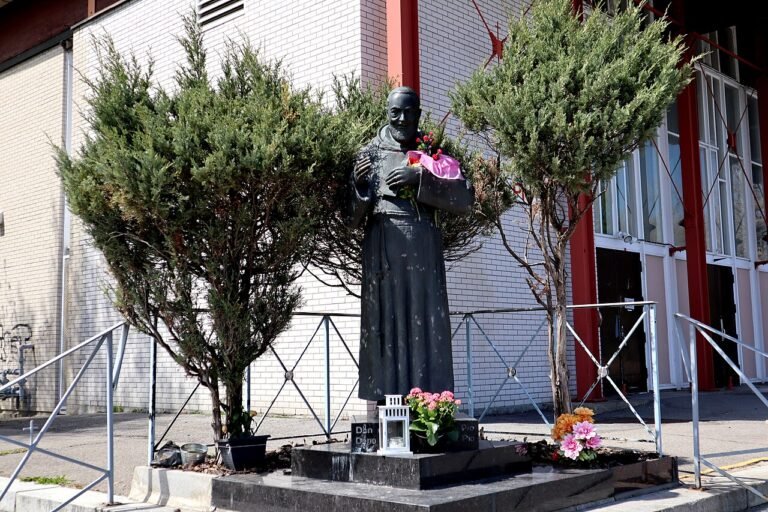
When we’re depressed or feeling blue, this prayer from Padre Pio is a way to reach out

1

If you find yourself in a state of darkness, the key is “to reach.”

The small framed unsigned print reads “Reach up as high as you can today, and God will reach down the rest of the way.” It’s my go-to quote for those times when I feel an emotional darkness—depression—coming on. For many of us this darkness is a familiar not-so-good old friend, the Black Dog mentioned by Sir Winston Churchill—or seasonal affective disorder.

The DSM (Diagnostic and Statistical Manual of Mental Disorders) has clinical definitions for depression, and there is as well the spiritual darkness that St. John of the Cross writes about in Dark Night of the Soul. However you’ve come to a depressive state, and for whatever history brought you there, the key in both of those dark times is to reach.

The state of darkness and depression is not a void. It is a space filled with insights that we are momentarily blinded to. When we try to go it alone, we are often too wearied to keep from going under, instead succumbing to the waves of hopelessness.

To reach is not an intuitive movement when psychologically and/or spiritually sinking into depression. Even though we’ve been taught that to despair is to turn our backs to God—which is a sin—there is another element to despairing that is sometimes overlooked. It comes from the Rule of St. Benedict, “In all things may God be glorified.”

In a recent confession, when I was in a season of depression, the priest gave me a very specific penance. I was to read about Jesus walking on stormy seas, and Peter’s fear in Matthew 14:30-31. Then reflect, specifically, on that moment when Peter is desperately reaching out to Our Lord—that second just before Jesus takes his hand.

It was a dark and doubt-filled moment for Peter, whose faith had faltered. It was also an intuitive response to a person physically drowning — reaching out, trying to grasp at anything to save his life.

Father gave me imagery by meditating on and fulfilling that penance; a metaphor to psychologically and spiritually reach for the hand of Christ. I was surprised by how quickly the instinct to survive spiritually soon matched the desire to live physically when exhausted and in deep waters.

Assured that the Lord had taken my hand so I will not drown, I often read this prayer, sometimes three times through!

Stay with me, Lord, for it is necessary to have you present so that I do not forget

you. You know how easily I abandon you.

Stay with me, Lord, because I am weak, and I need your strength, so that I may not

fall so often.

Stay with me, Lord, for you are my life, and without you, I am without fervor.

Stay with me, Lord, for you are my light, and without you, I am in darkness.

Stay with me, Lord, to show me your will.

Stay with me, Lord, so that I hear your voice and follow you.

Stay with me, Lord, for I desire to love you very much, and always be in your

company.

Stay with me, Lord, if you wish me to be faithful to you.

Stay with me, Lord, for as poor as my soul is, I want it to be a place of consolation

for you, a nest of love. Amen.

~St. Pio of Pietrelcina, Prayer After Communion

Depression is a battle, and for some of us a lifelong cross to bear. In bearing it as best we can while reaching up and out for help, we are led in to a deeper maturity of faith—which like most virtues, is not easily won.


Read more on Padre Pio:

When Padre Pio prayed for someone, he used this powerful prayer

A beautiful letter from St Padre Pio about your Guardian Angel and prayer

When Padre Pio felt “good for nothing” this is how he knew he wasn’t offending God

When Padre Pio prayed for someone, he used this powerful prayer

Thousands of miracles are the result of this simple prayer said by a saint.

Typically when someone asks us to pray for a specific intention, we have our “go-to” prayer. It might be the Rosary, an Our Father, or simply a heartfelt plea to God.

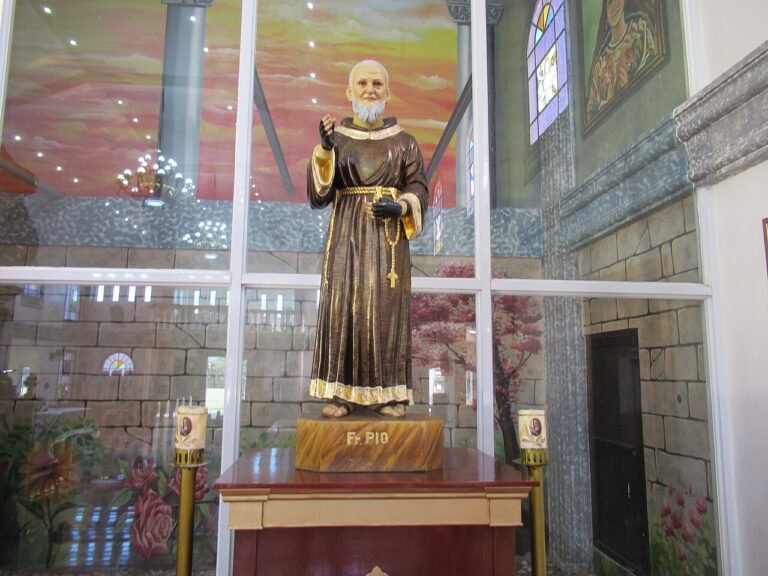
St. Pio of Pietrelcina (more commonly known as “Padre” Pio) had his favorite prayer that he prayed for everyone who asked for his prayers. Every day Padre Pio was asked by numerous people, whether in person or by letter, to pray for a specific intention and many times this intention was miraculously answered by God.

Below is the prayer that Padre Pio would pray each time he wanted to intercede for someone. It is actually a prayer composed by St. Margaret Mary Alacoque and is commonly called the “Efficacious Novena to the Sacred Heart of Jesus.” She was a saint who lived in the 17th century and during her lifetime received multiple visions of Jesus.

Many believe this is a powerful prayer because it calls upon the heart of Jesus to have mercy on us and our petitions. Jesus’ heart is indeed full of love and compassion and this prayer trusts in that love, believing that he is tender enough to generously grant our petition if it is in his holy will.

Above all things it must be prayed with a sincere faith, as Padre Pio would have prayed it, and not as a candy dispenser. God is not a genie who grants us whatever wish we desire, but instead responds in love to a child who asks for something, knowing exactly what we need.

I. O my Jesus, you have said: “Truly I say to you, ask and you will receive, seek and you will find, knock and it will be opened to you.” Behold I knock, I seek and ask for the grace of …… (here name your request)
Our Father …. Hail Mary …. Glory Be to the Father …. Sacred Heart of Jesus, I place all my trust in you.


II. O my Jesus, you have said: “Truly I say to you, if you ask anything of the Father in my name, he will give it to you.” Behold, in your name, I ask the Father for the grace of ……. (here name your request) Our Father …. Hail Mary ….Glory Be to the Father …. Sacred Heart of Jesus, I place all my trust in you.


III. O my Jesus, you have said: “Truly I say to you, heaven and earth will pass away but my words will not pass away.” Encouraged by your infallible words I now ask for the grace of ….. (here name your request) Our Father …. Hail Mary …. Glory Be to the Father … Sacred Heart of Jesus, I place all my trust in you.


O Sacred Heart of Jesus, for whom it is impossible not to have compassion on the afflicted, have pity on us miserable sinners and grant us the grace which we ask of you, through the Sorrowful and Immaculate Heart of Mary, your tender Mother and ours.
Say the Hail, Holy Queen and add: St. Joseph, foster father of Jesus, pray for us.

Here’s how to celebrate Easter Monday at home

0

Here you have the prayers, readings, and everything else you need to celebrate with God’s Word.

The celebration of Easter takes place over the next seven weeks, and will be crowned by Pentecost. Until the end of social distancing, We will offer you a daily celebration of the Word of God at home to sanctify every day of the Easter season. In collaboration with Magnificat magazine

Instructions:

This celebration requires the presence of at least two people. If you are alone, it is preferable to simply read the readings and prayers found in the proposed celebration. This celebration is particularly suitable for use with family. In order to respect quarantine measures, you should refrain from inviting others from outside your household. If anyone in your house is ill, make sure they remain in isolation to ensure that all safety guidelines are strictly followed.

Set up the needed number of chairs in front of a prayer corner, respecting distance between them. Light one or more candles, placing them on non-flammable stands (such as candlesticks or small porcelain plates). Don’t forget to blow them out at the end of the celebration. Place some flowers and decorations as a sign of joy. A simple cross or crucifix should always be visible in the background.

Designate a person to lead the prayer. He or she will also determine the length of the periods of silence. Designate a reader.

EASTER MONDAY

Celebration of the Word

Let us fix our eyes on Jesus Christ, our hope, our light, and our salvation.

All are seated.

The leader of the celebration reads:

Brothers and sisters,

On Easter morning, a new dawn arose

of a humanity transfigured by the resurrection

of Jesus of Nazareth, our God and Savior.

In the infinite love of our Father in heaven,

He has given us the supreme testimony of his tenderness:

To redeem us from the powers of evil and death

Which had taken us hostage,

He has ransomed us with his beloved Son,

The only begotten of his love,

Going so far as to give him to us as a brother in humanity,

So that with him we can win

The victory of love, the victory of life

And that in him we may inherit eternal happiness.

Throughout our earthly tribulations,

he is our Hope!

he is our light and our Salvation!

Enlightened by his divine light, we become aware

our limitations and our weakness,

and the damage our sins cause.

But spurred on by our Hope,

we want to tell him of our faith in his Resurrection,

and thank him for giving us

the greatest proof of love:

his life for the glory of God.

and the Salvation of the world!

Pause

O Jesus, we are prevented from

perpetuating the offering of your life

by the celebration of the Eucharist:

more than ever, we ask you to make it present

in the way we love each other

as you loved us.

After three minutes of silence, all rise and make the Sign of the Cross, saying:

In the name of the Father, and of the Son, and of the Holy Spirit. Amen.

The leader continues:

To prepare ourselves to receive God’s Word

and in order for it to heal us,

we recognize ourselves as sinners.

The penitential rite follows. For example:

Have mercy on us, O Lord.

For we have sinned against you.

Show us, O Lord, your mercy.

And grant us your salvation.

May Almighty God have mercy on us;

forgive us our sins,

And bring us to everlasting life.

Amen.

The following is said or sung:

Lord, have mercy.

Lord, have mercy.

Christ, have mercy.

Christ, have mercy.

Lord, have mercy.

Lord, have mercy.

PRAYER

The leader says the opening prayer:

The Lord has risen from the dead, as he said;

let us all exult and rejoice,

for he reigns for all eternity, alleluia. Alléluia.

FIRST READING  (Acts 2:14, 22-33)

A reading from the Acts of the Apostles.

On the day of Pentecost, Peter stood up with the Eleven,

raised his voice, and proclaimed:

“You who are Jews, indeed all of you staying in Jerusalem. Let this be known to you, and listen to my words.

“You who are children of Israel, hear these words. Jesus the Nazorean was a man commended to you by God with mighty deeds, wonders, and signs, which God worked through him in your midst, as you yourselves know.

This man, delivered up by the set plan and foreknowledge of God, you killed, using lawless men to crucify him.

But God raised him up, releasing him from the throes of death, because it was impossible for him to be held by it.

For David says of him:

I saw the Lord ever before me, with him at my right hand I shall not be disturbed.

Therefore my heart has been glad and my tongue has exulted; my flesh, too, will dwell in hope, because you will not abandon my soul to the nether world, nor will you suffer your holy one to see corruption.

You have made known to me the paths of life; you will fill me with joy in your presence.

My brothers, one can confidently say to you about the patriarch David that he died and was buried, and his tomb is in our midst to this day.

But since he was a prophet and knew that God had sworn an oath to him that he would set one of his descendants upon his throne, he foresaw and spoke of the resurrection of the Christ, that neither was he abandoned to the netherworld nor did his flesh see corruption.

God raised this Jesus; of this we are all witnesses. Exalted at the right hand of God, he poured forth the promise of the Holy Spirit that he received from the Father, as you both see and hear.”

The Word of the Lord.

Thanks be to God.


PSALM (16:1-2a and 5, 7-8, 9-10, 11)

R/ Alleluia ! Alleluia ! Alleluia !

Keep me, O God, for in you I take refuge;

I say to the LORD, “My Lord are you.”

O LORD, my allotted portion and my cup,

you it is who hold fast my lot. R/


I bless the LORD who counsels me;

even in the night my heart exhorts me.

I set the LORD ever before me;

with him at my right hand I shall not be disturbed. R/


Therefore my heart is glad and my soul rejoices,

my body, too, abides in confidence;

Because you will not abandon my soul to the nether world,

nor will you suffer your faithful one to undergo corruption. R/


You will show me the path to life,

fullness of joys in your presence,

the delights at your right hand forever. R/

GOSPEL (Mt 28:8-15)

Alleluia. Alleluia.

This is the day the LORD has made;

let us be glad and rejoice in it.

Alleluia.

A reading from the holy Gospel according to Matthew.

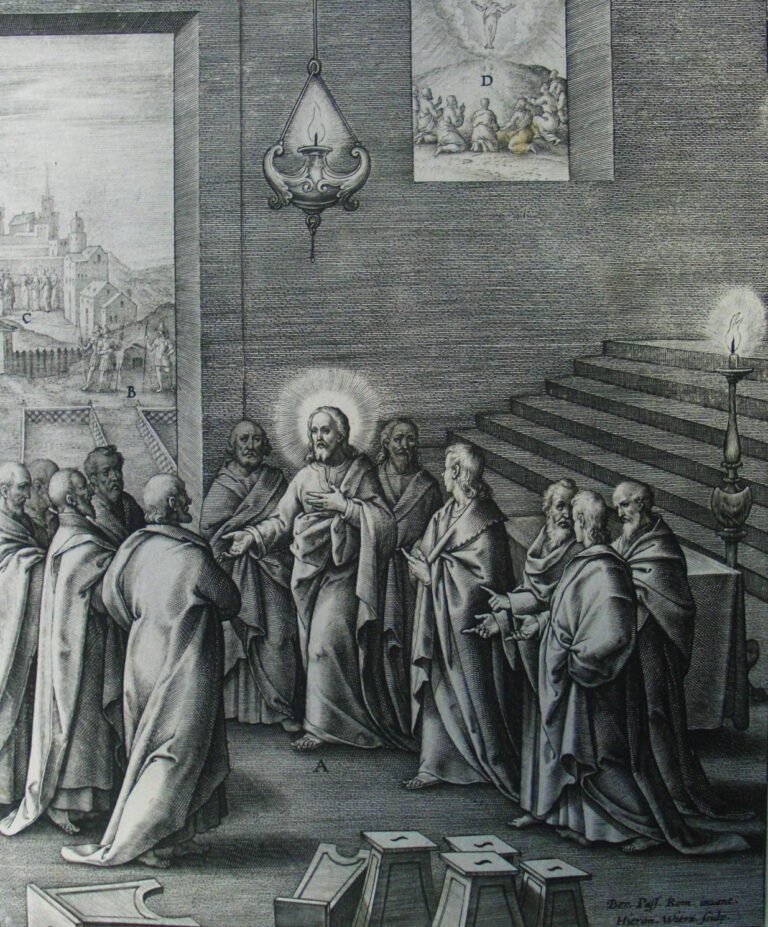
Mary Magdalene and the other Mary went away quickly from the tomb, fearful yet overjoyed, and ran to announce the news to his disciples. And behold, Jesus met them on their way and greeted them. They approached, embraced his feet, and did him homage. Then Jesus said to them, “Do not be afraid. Go tell my brothers to go to Galilee, and there they will see me.”

While they were going, some of the guard went into the city and told the chief priests all that had happened. The chief priests assembled with the elders and took counsel; then they gave a large sum of money to the soldiers, telling them, “You are to say,
‘His disciples came by night and stole him while we were asleep.’ And if this gets to the ears of the governor, we will satisfy him and keep you out of trouble.”

The soldiers took the money and did as they were instructed.

And this story has circulated among the Jews to the present day.

No acclamation concludes the reading of the Gospel.

All are seated, and the leader repeats slowly,

as if it were a far-off echo:

In the depths of our heart,

let us listen to the echo these words of the Son to his Father,

words which each of us has received the grace to make our own:

“You will show me the path to life,

fullness of joys in your presence,

the delights at your right hand forever.”

All observe five minutes of silence for silent personal meditation.

The leader indicates the end of the period of silence, and invites all to rise.

The leader introduces the Lord’s Prayer:

United in the Spirit and in the communion of the Church,

we dare to pray as the Lord Jesus himself

taught us:

All say or sing the Our Father:

Our Father…

Continuing immediately with:

For the kingdom…

Then the leader invites those present to share a sign of peace:

We have just joined our voices

with that of the Lord Jesus to pray to the Father.

We are sons and daughters in the Son.

In the love that unites us with one another,

renewed by the word of God,

we can exchange a gesture of peace,

a sign of the communion

we receive from the Lord.

All then exchange a greeting of peace from a distance: for example, by bowing deeply towards each

other in turn; or, as a family, by blowing each other a kiss. Then all sit down.

SPIRITUAL COMMUNION

The leader says:

When we cannot receive sacramental communion for lack of a Mass, Pope Francis urges us to practice spiritual communion, also called “communion of desire.”

The Council of Trent reminds us that this “consists in an ardent desire to feed on the Heavenly Bread, with a living faith that acts through charity and that makes us participants in the fruits and graces of the Sacrament.” The value of our spiritual communion depends therefore on our faith in the presence of Christ in the Eucharist as a source of life, love and unity, and our desire to receive Communion in spite of our inability to do so.

With that in mind, I now invite you to bow your head, to close your eyes and recollect yourselves.

Silence

Deep in our hearts,

may a burning desire arise within us to unite ourselves with Jesus,

in sacramental communion,

and then to bring His love to life into our lives,

loving others as He loved us.

All remain in silence for 5 minutes for a

heart-to-heart conversation with Jesus Christ.

A hymn of thanksgiving may be sung.

All stand.

All recite together the following prayer:

May the grace of this paschal mystery

abound in our minds, we pray, O Lord,

and make those you have set on the way of eternal salvation

worthy of your gifts.

Through Christ our Lord. Amen.

FINAL BLESSING

The leader of the celebration, with hands joined in prayer,

says the blessing in the name of all:

Through the intercession of St. N.

[patron saint of the parish, diocese or country],

and of all the saints of God,

May the God of perseverance and courage

grant us to manifest throughout our lives

the spirit of sacrifice, compassion and love

of Christ Jesus.

Thus, in the communion of the Holy Spirit,

we will give glory to God,

the Father of our Lord Jesus Christ,

for ever and ever!

Amen.

All together facing the cross, each with their hands joined in prayer,
invoke the Lord’s Blessing:

May the Lord let his face shine upon us

and come and save us. Amen.


All make the Sign of the Cross.

Then parents may trace the Sign of the Cross on their children’s foreheads.

To conclude the celebration, the participants may sing the Regina Caeli,

or some other joyful, well-known Marian hymn.

Regína caéli, lætáre, Allelúia!

Quia quem meruísti portáre, Allelúia!

Resurréxit, sicut dixit, Allelúia!

Ora pro nóbis Déum, Allelúia!


O Queen of heaven rejoice! Alleluia!

For He whom thou didst merit to bear, Alleluia!

Hath arisen as he said, Alleluia!

Pray for us to God, Alleluia!