The Vatican has published the rite for the Requiem Mass for Pope Emeritus Benedict XVI, which will be celebrated on Thursday at 9:30 AM Rome time.
The booklet for the Mass is based largely on the Rite of Christian Burial of a Supreme Pontiff with several modifications.
Matteo Bruni, the Director of the Holy See Press Office, told reporters on Tuesday that some portions have been added, while others more relevant to the death of a reigning Pope have been taken out.
As an example, he said the supplications for the Diocese of Rome and the Oriental Churches have been removed.
Liturgical readings
Pope Francis will preside over the Requiem Mass, deliver the homily, and celebrate the Rites of Commendatio and Valedictio.
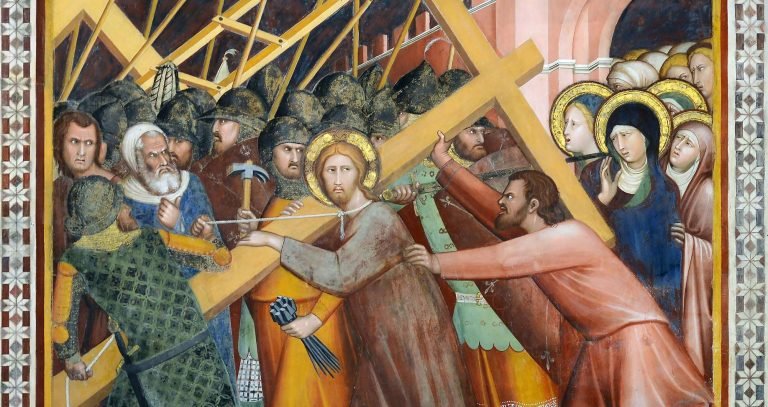
The Gospel passage for the liturgy comes from Luke (23:39-46), where Jesus, hanging on the Cross, tells one of the men condemned with Him that he will be with Him in paradise.
Jesus’ final words—“Father, into your hands I commend my spirit”—are also recounted in the passage.
Those words are not so dissimilar to the last words of Pope Emeritus Benedict XVI: “Jesus, I love you.”
Burial details
Mr. Bruni also provided details of the objects which will be placed in the cypress-wood coffin with the late Pope Emeritus.
These include the episcopal Pallia—the pallium symbolizes a prelate’s ecclesiastical jurisdiction and special relationship with the Pope—as well as the commemorative coins and medals which were coined during his papacy, and the deed (“rogito” in Italian), a written text describing his pontificate, sealed in a metal cylinder.
At the end of the Requiem Mass, the mortal remains of the Pope Emeritus will be taken to the Grottos under St. Peter’s Basilica, where his coffin will be put inside a zinc coffin, which in turn will be put inside a wooden case and buried.
Pope Emeritus Benedict XVI will be laid to rest in the tomb where St. John Paul II had been buried before his beatification.
Lying-in-state
The late Pope Emeritus continues to lie in state in St. Peter’s Basilica, where the faithful can pay their respects from 7 AM to 7 PM on Wednesday.
As of Tuesday morning, over 100,000 pilgrims had made their way through the Basilica.
The Dicastery for Communication, with the support of the Knights of Columbus, is providing media facilities and audio-video links to ensure the worldwide broadcast of the Requiem Mass for the late Benedict XVI.
The mortal remains of Pope Emeritus Benedict XVI were moved early in the morning on Jan. 2, 2023, from his former residence in the Vatican’s Mater Ecclesiae Monastery to St. Peter’s Basilica, where the late pope is lying in state through Jan. 4. Thousands waited in line to pay their respects. | Daniel Ibañez / EWTN
Following the death of Pope Emeritus Benedict XVI, these are the details you should know about his funeral in the Vatican.
Benedict XVI passed away on Dec. 31 at 9:34 a.m. Rome time. As confirmed by his personal secretary Archbishop Georg Gänswein, his last words were “Signore, ti amo !” (Lord, I love you!) And he pronounced them in Italian.
Unlike the death of St. John Paul II in 2005, the death of the pope emeritus was not announced in St. Peter’s Square nor was there a peal of bells. Confirmation of his death was reported by the director of the Vatican Press Office, Matteo Bruni.
Bruni told reporters that “following the wishes of the pope emeritus, the funeral will be held under the sign of simplicity,” stressing that it will be a “solemn but sober funeral.”
“The express request on the part of the emeritus pope is that everything be simple, both with regard to the funeral as well as the other celebrations and gestures during this time of pain,” he added.
After his death, the body of Benedict XVI remained in the Mater Ecclesiae Monastery, his place of residence since his resignation in 2013. The small monastery is located in the Vatican Gardens on a hill behind St. Peter’s Basilica.
On Jan. 1, the Holy See released the first images of the body of the pope emeritus with a rosary in his hand and lying at the foot of the altar in the monastery’s chapel. The chapel is the same place where, in addition to celebrating Mass, public visits from Pope Francis and the new cardinals were made every time there was a consistory in the Vatican. Since it continues to be Christmas liturgically, the chapel still has a small Christmas tree and a manger.
Next to the remains of Benedict XVI, some kneelers were placed for prayer.
A few hours later dozens of people including cardinals, bishops, priests, Vatican workers, nuns from different congregations, and even journalists who cover the activities of the Holy See were able to enter the monastery to keep vigil and pray with the remains of the pope before they were transferred to St. Peter’s.
At 7 a.m. on Jan. 2,the body of the Pope Emeritus was transferred from theMater Ecclesiae Monastery to St. Peter’s Basilica to begin the wake and allow thousands of pilgrims to say their last goodbyes.
The archpriest of the basilica, Cardinal Mauro Gambetti, received the remains of Benedict XVI with a liturgical act that lasted about 30 minutes.
Among the attendees were Gänswein, who was his personal secretary since 2003, and the master of liturgical celebrations, Monsignor Diego Ravelli.
From 9 a.m. to 7 p.m. the faithful from all over the world were allowed to enter St. Peter’s Basilica to visit the body of Benedict XVI.
It is estimated that at least 65,000 people came to visit the pope emeritus on the first day of his wake.
The remains of Benedict XVI will remain on display in St. Peter’s Basilica until Wednesday, Jan. 4. Visiting hours for Tuesday and Wednesday are from 7 a.m. to 7 p.m. (Rome time).
Funeral of Benedict XVI
Pope Francis will preside over the funeral of Benedict XVI on Thursday, Jan. 5, at 9:30 a.m. (Rome time), in St. Peter’s Square.
The Vatican has released the booklet containing the prayers and readings for the funeral Mass. The readings for the Mass will be Isaiah 29:16–19 in Spanish; Psalm 23 sung in Latin; 1 Peter 1: 3–9 in English, and the Gospel of Luke 23: 39–46 read in Italian.
Two official state delegations, those of Italy and Germany, will attend the funeral of Pope Emeritus Benedict XVI.
The president of Italy, Sergio Mattarella, was one of the first to visit the funeral chapel of Pope Benedict XVI. Prime Minister Giorgia Meloni, accompanied by other officials from her government, also attended on the morning of Monday, Jan. 2, and prayed for several minutes before the remains of the pope emeritus.
Many other heads of state will come to pay respects and attend the funeral in an unofficial capacity, including the president of Hungary, Katalin Novak; the president of Poland, Andrzej Duda; King Philip of Belgium; and Queen Sofia of Spain, among others.
As Benedict XVI’s coffin is carried to his place of burial in the crypt of St. Peter’s Basilica, the choir will sing the Magnificat in Latin.
If you consider that God is righteous, you also know that everyone who acts in righteousness is begotten by him. See what love the Father has bestowed on us that we may be called the children of God. Yet so we are. The reason the world does not know us is that it did not know him. Beloved, we are God’s children now; what we shall be has not yet been revealed. We do know that when it is revealed we shall be like him, for we shall see him as he is. Everyone who has this hope based on him makes himself pure, as he is pure. Everyone who commits sin commits lawlessness, for sin is lawlessness. You know that he was revealed to take away sins, and in him there is no sin. No one who remains in him sins; no one who sins has seen him or known him.
R. (3cd) All the ends of the earth have seen the saving power of God. Sing to the LORD a new song, for he has done wondrous deeds; His right hand has won victory for him, his holy arm. R. All the ends of the earth have seen the saving power of God. All the ends of the earth have seen the salvation by our God. Sing joyfully to the LORD, all you lands; break into song; sing praise. R. All the ends of the earth have seen the saving power of God. Sing praise to the LORD with the harp, with the harp and melodious song. With trumpets and the sound of the horn sing joyfully before the King, the LORD. R. All the ends of the earth have seen the saving power of God.
R. Alleluia, alleluia. The Word of God became flesh and dwelt among us. To those who accepted him he gave power to become the children of God. R. Alleluia, alleluia.
John the Baptist saw Jesus coming toward him and said, “Behold, the Lamb of God, who takes away the sin of the world. He is the one of whom I said, ‘A man is coming after me who ranks ahead of me because he existed before me.’ I did not know him, but the reason why I came baptizing with water was that he might be made known to Israel.” John testified further, saying, “I saw the Spirit come down like a dove from the sky and remain upon him. I did not know him, but the one who sent me to baptize with water told me, ‘On whomever you see the Spirit come down and remain, he is the one who will baptize with the Holy Spirit.’ Now I have seen and testified that he is the Son of God.”
It is not only a good practice to begin and go through each day with a daily prayer, but essential. Prayers are the only way we can communicate with God and the only way he can communicate back. It is essential to have a daily prayer routine beginning in the morning after waking up and at every stage during the day till you go back to bed.
A daily prayer routine starts in the morning with a prayer to thank God for waking up, then before each meal, also before facing any challenging situation for you or those around you, and finally before going to bed. Some prayers you can use are prayers like:
Daily Prayer for Strength
Oh Lord my God, You give me all the strength that I need in life. As I undergo this trying moment, offer me a yoke that is good to bear and a burden that is light.
Dear Father, You may take away this burden that I have, but if it is Your will that bears it, then shower me with Your strength and fortitude.
Dear Lord, do not leave me alone for sometimes I feel like letting go. The fear and the pain that engulfs me is a bit too much, and I feel that I do not have the strength to push through on my own.
Lord Jesus, You have assured us that when we turn to You, You will always hear our prayers. I know that I am undergoing this because of a sin I have committed or in preparation for higher service to You. Therefore Lord God, grant me the strength that I need today, and may Your will be done in my life.
Forgive me my sins and guide me so that I do not fall into temptations. Focus Your eyes on me for all my hopes rest in You. I pray this in the mighty name of Jesus. Amen
Daily Morning Prayer
Lord God, let me not be separated from You today. Help me to choose to do Your will today and may everything I do be good and according to Your Holy Will. May I be of benefit to my family, friends, neighbours, and the entire community.
Dear Lord, May every step I take and every move I make lead me closer to You. Help me to not work by my feelings, but by Your Word. Protect me from my own sinful thoughts, words, and actions and keep my heart pure and unblemished.
Lord God, suppress my selfish wants and vain thoughts and help me embrace Your Wish for me today. Father, help me to accept all that comes my way today as a lesson and an opportunity rather than an inconvenience. Father, always help me to remember that You are always a gift in my life. Amen.
Thy kingdom come. Thy will be done on earth as it is in heaven.
Give us this day our daily bread, and forgive us our trespasses,
as we forgive those who trespass against us, and lead us not into temptation,
but deliver us from evil.
For the kingdom, the power, and the glory are Yours, now and forever. Amen.”
Daily Prayer for School
Lord God, we bring our school into Your mighty hands. May You bless the learners, teachers, and staff who work here so that the learning process, to discover how great You are, happens smoothly.
May You, Almighty God, make our school be a place of great discovery, adventure, and also a place where we all learn to love as well love to learn.
Help us to respect, value, and treat each other as brothers and sisters. We pray this through Jesus Christ our Lord and saviour. Amen.
Daily Evening Prayer
O Lord, I thank You very much for all the graces I have received from You today. Forgive me, Dear Lord, if I have not utilized them to the fullest and I beg that You give me another chance to utilize them.
Lord God, I resent all the sins that I have committed against You. I beg for Your forgiveness. Shower me with Your grace and love so that I do not repeat the sins.
My Lord Jesus, have pity on me and all my loved ones and protect us this night. My dear Blessed Mother Mary pray for me for protection this night.
May St. Joseph, angels, and all the saints in heaven pray for me tonight so that I may be protected from snares of sin and evil. Amen.
Daily Night Prayer
Almighty and ever-living God, I am guilty of forgetting that You are with me always. I also forget how good You have been to me. I am sincerely sorry for that.
Dear Lord, I am thirsting to know You more and more. I want to better understand Your promises and Your teachings so that I can learn to put You first in everything I do in life.
Oh Lord my God, You told us not to worry about tomorrow but focus instead on our God-given tasks today. Help me then to live one day at a time.
Tonight Dear Lord, I place my trust in the promises You have made to mankind that when we know, love, serve praise and glorify You, You will take care of all our relational, spiritual, emotional, financial, social and physical needs. Help me to worry less and to trust You more and more. In Jesus’ name, I pray and believe. Amen.
Daily Prayer for Blessing
Oh Lord my God, You are Holy indeed, the fountain of all Holiness. You have blessed me in every way for I have been faithful to You despite falling by the wayside every now and then.
Father, I cannot count the many blessings You have given me. I cannot thank You enough for the overflowing graces and unconditional love that You have showered down upon me without expectations and without measure.
Dear Lord, I beg You to continue showering me with Your immense blessings, love, and graces and protect me from the evil one. Lord, I worship and adore You and I bless Your holy name forever and ever. Amen.
Daily Prayer for Family
Oh Lord my God, I pray that You protect my family. Grant today, safety to my spouse, my children, my parents, my family members, and me too.
Dear Lord, let Your mighty hand lead all of us through the correct path that You have prepared for us today.
Remove all enemies and forces of the evil one from our path, so that they may not hinder us from serving You today. May Your light shine brightly along our path so that we may not get blinded by the evil one.
We know that nobody can be against us because You are for us. Please, dear Lord, guide and watch over all of us today so that we may go and come back home safely after serving You today. Amen.
Daily Prayer for Dedication to God
Oh my God and creator of heaven and earth, I come before You with great humility. Together with all Angels and Saints, I adore and glorify You for You are my Creator, my Alpha and Omega.
I offer You my life and being and I submit to Your Holy Will and dedicate myself today to Your divine service. Amen.
Daily Meditation Prayer
Lord Jesus Christ, You taught us to slip away to a quiet and serene place to pray and meditate when the world’s turbulence comes our way.
Lord Jesus, You gave us the perfect example of always praying and meditating when our willpower is pushed beyond limits, for it is the best alternative to resulting in anger, anxiety, and frustration.
Lord God, whenever we are unable to pray, You usually know our needs and the wishes of our hearts. Please, sweet Jesus, help us to continue doing Your Holy will and walking in Your path.
We also pray, dear Heavenly Father, for those who do not believe in You and have no personal communion with you.
Walk beside us dear Lord so that we can become the salt of the earth and the light of the world. May Your peace, joy, and love be felt by all people we come across.
May we become living witnesses of Your goodness and providence, and may Your mighty name be glorified forever and ever. Amen.
Daily Prayer – Jesus Daily Prayer
“God, thank you that you are the one who can change me. Lord thank you that I do not have to change myself. Thank you, Jesus Christ, for dying so that we could have a life. Help us not to judge others for their sin, but to treat them with love and humility. Help us come to you just as we are: broken, flawed, but fully alive and revived by the power of your blood on the cross. Thank you Jesus! The gospel is such good news. Help me live into that each day. Amen.”
Daily Prayer for Myself
“Lord, please pardon me for the times I have said and done things without foresight. Father, please remind me to consider self-control as “God-control”. It is not simply trying to control myself with human effort. But it is instead depending on the Holy Spirit to guide my way and choices.
Dear Lord Jesus Christ, You overcame Satan in his attempts to tempt you to show Your power with a spirit of self-control. Now I call upon Your blessed Name. I ask You to bless me with the same virtue, which is very much needed in most aspects of my life. Lord, I seek Your assistance and guidance. May Your Holy Spirit fill me with power, as I come in prayer and raise my petitions before You.”
Daily Prayer – Prayer for peace
“Lord, who is more than we can ever understand, help us to find you, and you alone. Father help us to stand before all that we can do and look for what you would do, and emulate that. Lord lift from us our need to achieve all that we can be and instead, surrender to what you want us to be. Give us ways to refrain from the busyness that will put us on edge and off balance, give us today your peace.”
Amen.
Daily Prayer – Prayers of Hope
“Blessed father, I am your humble servant, I come before you on this day in search of hope. For there are times when I feel helpless, and there are times when I feel weak. Father, I pray for hope.
I need hope for a better future, hope for a better life, Lord I need hope for love and kindness. Some people say that the sky is at it’s darkest just before the dawn. I pray that this is true, for all seems dark at the moment. I need your light, Lord, in every way. Father I pray to be filled with your light from head to toe. To soak in your glory. To know that all is right with the world, as you have planned, and as you want it to be.
Help me to walk in your light, and live my life in faith and glory. In your Name. I pray. Amen.”
Daily Prayer – Prayer for Today
“Father, we pray that by Your grace, we’ll bear witness at the end of this day. We will do this by walking in Your divine light and You’ll see us through Blessed God. Your company will encourage us to keep going when we want to give up Lord. Your will shall renew our hope when our hopes waver. Father, no circumstance that’ll harm us shall occur today. but instead, happiness and miracles are what we’ll experience by Your hand on this day. We appreciate Your everlasting love Father and in Your Name, we pray. Amen.”
Daily Prayer – Intercessory Prayer
” Save us, O God, and have mercy upon the old, the young, the needy, the orphans, the widows, and on all who are in sickness and sorrow, in trouble and affliction, in oppression and captivity, in prison and captivity. More importantly have mercy upon Your servants who are under persecution for Your sake and for the sake of the Christian Faith at the hands of heathen nations, of apostates, and of heretics: remember them, visit and strengthen them, comfort them Lord, and by your Graces grant them, by Your power, relief, freedom, and deliverance. Amen “
Benedict XVI will be interred in the Vatican crypt in the same location as Pope John Paul II, who was later beatified. This location is fewer than 100 feet from the tomb of St. Peter the Apostle and is on the north side of the central part of the Vatican crypt.
There is an image of the Virgin Mary and the child Jesus flanked by angels above the spot, and the sarcophagus of Queen Christina of Sweden can be found to the right.
Benedict XVI’s funeral Mass will take place on January 5th, after which his coffin will be carried to the crypt for interment. This information was confirmed by Vatican spokesman Matteo Bruni on January 2nd, the first day that Benedict XVI’s body was laid in state in St. Peter’s Basilica.
Benedict XVI passed away at the age of 95 on December 31st.
When Pope Benedict XVI resigned in 2013, he stepped down as the bishop of Rome — and out of his famous red leather shoes.
During his reign as pope, Benedict’s red shoes became something of a trademark, inspiring ABC News to call him a “fashionista” and Esquire to name him “accessorizer of the year.” At another point, his loafers sparked controversy after false rumors claimed they were crafted by the high-end Italian fashion house Prada.
Benedict’s choice of shoes stands out because his predecessor and successor — St. John Paul II and Pope Francis — opted for alternatives. But popes have walked in red for centuries.
In photos of Benedict’s mortal remains released by the Vatican today, he is dressed in red and gold vestments and ordinary black clerical shoes.
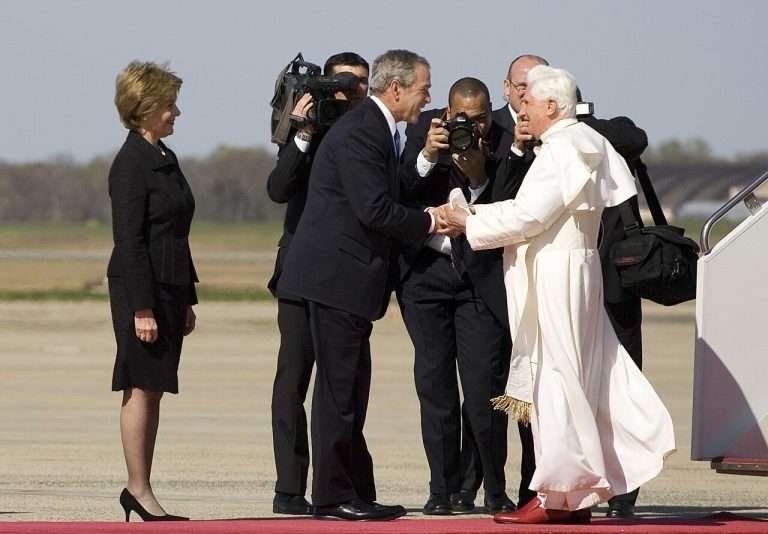
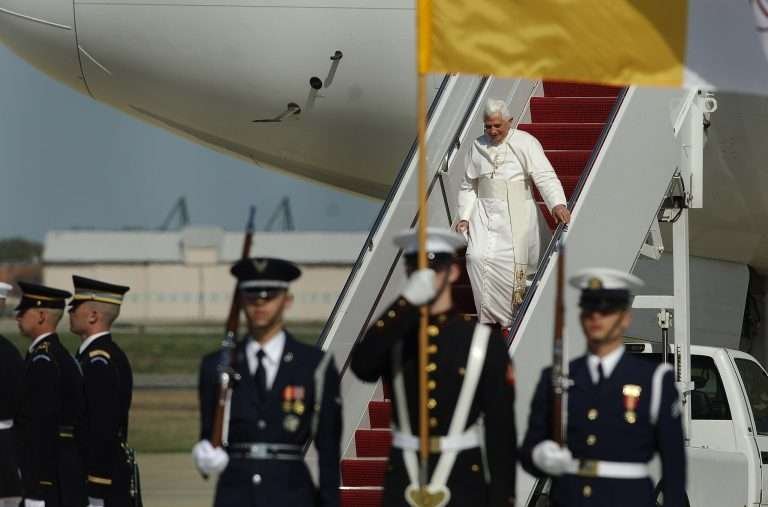
Pope Benedict XVI is greeted by Australian Prime Minister Kevin Rudd (R) following his arrival in Australia ahead of World Youth Day 2008 at Richmond RAAF Base on July 13, 2008, in Sydney, Australia. Sergio Dionisio/Getty Images
Far from a fashion statement, in the Catholic faith, red symbolizes martyrdom and the Passion of Christ.
In other words, they signify the pope following in the footsteps of Christ.
Two Italian cobblers are credited with fashioning Benedict’s shoes during his pontificate: Adriano Stefanelli and Antonio Arellano.
Stefanelli, an Italian craftsman, has created shoes for a long list of notable leaders, including St. John Paul II, Barack Obama, and George W. Bush, according to Italy’s ANSA news.
He first delivered shoes to the Vatican when he witnessed John Paul II in pain in 2003, He asked himself what he could do, personally, to help. He decided on shoes.
That tradition continued with Benedict XVI.
The “greatest satisfaction is to see, looking at the photos and images of Benedict XVI, that the shoe is, as they say informally, well ‘used and carried,’ [and] therefore comfortable,” he told L’Osservatore Romano.
Another artisan, Arellano, mended shoes for Benedict back when he was a cardinal. Originally from Trujillo, Peru, Arellano moved to Rome in 1990 to open a shoe repair shop by the Vatican.
When his friend the cardinal became pope, he was elated.
“Everyone was running through the streets, and I saw Cardinal Ratzinger appear on television,” he previously told CNA. “I was amazed because he was my customer and I was so happy.”
Arellano said he remembered Benedict’s shoe size — 42 — and decided to give the new pope a pair of red shoes during a general audience at the Vatican.
“When we got there to greet him, the pope recognized me, smiled, and said, ‘Here is my shoemaker.’ It was a wonderful moment, because he makes you feel important,” Arellano remembered. “He gave a blessing to me and my family and we said goodbye.”
That gift resulted in the Vatican requesting another pair of shoes for the pontiff to wear during the beatification of John Paul II.
“It was awesome, because then I really did feel like I was the Holy Father’s shoemaker,” he said, adding that “it’s one thing to give the pope a present; it’s another for them to call you to specifically make some shoes for him.”
When he retired, the pope emeritus put away his red shoes in favor of leather loafers designed by a Mexican Catholic cobbler, Armando Martin Dueñas. Those three pairs — two burgundy, one brown — came to him as another gift.
The last words of Pope Emeritus Benedict XVI as he lay on his deathbed were “Lord, I love you!” according to the late pope’s longtime personal secretary Archbishop Georg Gänswein, Vatican News reported.
At about 3 a.m. on Dec. 31, a few hours before he died, Benedict was alone with a nurse who did not speak German, Vatican News reported. At that time Gänswein and others who were taking turns staying with the pope emeritus had left the room for a moment.
Gänswein recounted that Benedict XVI “in a soft but clearly distinguishable voice said in Italian, ‘Lord, I love you!’”
Gänswein said: “I was not there at the time, but the nurse told me shortly afterwards. Those were his last comprehensible words because after that he was no longer able to express himself.”
The pope emeritus’ death was announced in Rome on Dec. 31. His solemn funeral Mass will be on Thursday, Jan. 5, at 9:30 a.m. Rome time in St. Peter’s Square, with Pope Francis presiding. Benedict XVI will be buried in the Vatican crypt following the funeral.
“In accordance with the wish of the pope emeritus, the funeral will be carried out under the sign of simplicity,” the Vatican press office director, Matteo Bruni, said. Bruni told journalists in a news briefing Dec. 31 that Benedict received the sacrament of anointing of the sick on Dec. 28.
Benedict XVI’s body will lie in state in St. Peter’s Basilica beginning on Monday, Jan. 2.
You can watch EWTN’s live coverage of Benedict’s death from Rome here.
Pope Emeritus Benedict XVI has died at the age of 95, bringing to a close the momentous life of a Churchman who proclaimed the “eternal joy” of Jesus Christ and called himself a “humble worker” in the vineyard of the Lord.
His death was announced in Rome on Dec. 31.
Cardinal Joseph Aloisius Ratzinger was elected pope on April 19, 2005, and took the name Benedict XVI. Eight years later, on Feb. 11, 2013, the 85-year-old shocked the world with the announcement — made in Latin — that he was resigning from the papacy. It was the first resignation of a pope in nearly 600 years. He cited his advanced age and lack of strength as unsuitable for the exercise of his office.
However, the enormous legacy of his theologically profound contributions to the Church and the world will continue to be the source of reflection and study.
Even before his election as pope, Ratzinger exerted a lasting influence on the modern Church, first as a young theologian at the Second Vatican Council (1962–1965) and later as prefect of the Vatican’s Congregation (now Dicastery) for the Doctrine of the Faith.
An articulate defender of Catholic teaching, he coined the term “dictatorship of relativism” to describe secularism’s increasing intolerance of religious belief in the 21st century.
Benedict’s pontificate was shaped by his deep understanding of this challenge to the Church and Catholicism in the face of rising ideological aggression, not least from an increasingly secular Western mindset, both within and outside the Church.
Benedict was also a key architect of the fight against sexual abuse in the Church in the early 2000s. He oversaw extensive changes to canon law and dismissed hundreds of offenders from the clerical state. He also launched a canonical investigation of the Legionaries of Christ, following growing allegations about grave sexual abuses from the order’s founder, the Mexican priest Marcial Maciel Degollado. The canonical investigation led to a long reform process under the authority of Cardinal Velasio de Paolis.
Millions have read Benedict’s books, including the groundbreaking 1968 “Introduction to Christianity” and the three-volume “Jesus of Nazareth,” published from 2007 to 2012, during his time as pope.
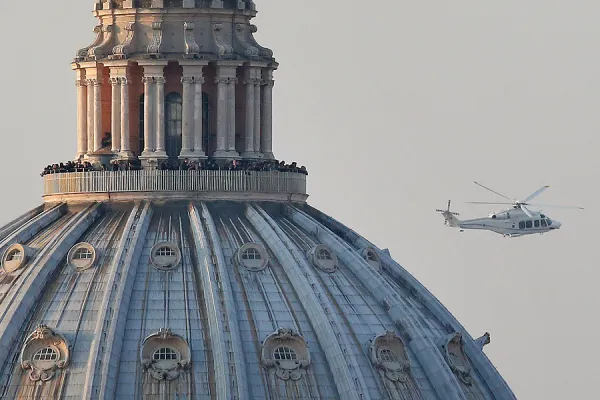
He was the first pope to resign from office in almost 600 years. He traveled from Vatican City to Castel Gandolfo by helicopter on Feb. 28, 2013, and took up life in retirement the following May in the Mater Ecclesiae monastery in the Gardens of the Vatican City State.
A helicopter carries Pope Emeritus Benedict XVI as he officially retires in Vatican City on Feb. 28, 2013. Getty Images News/Getty Images.
“I’m simply a pilgrim who is starting the last stage of his pilgrimage on Earth,” he said in his final words as pontiff. “Let’s go ahead together with the Lord for the good of the Church and of the world.”
He was known for his love of music — he played Mozart and Beethoven on the piano — as well as cats, Christmas cookies, and occasional draughts of German beer. The late pope was also renowned for his gentleness, courtesy, and for being a true child of Bavaria.
A higher call at a time of war
Joseph Ratzinger was born on April 16, 1927, Holy Saturday, in the Bavarian town of Marktl am Inn. His parents, Joseph and Maria, raised him in the Catholic faith. His father — a member of a traditional Bavarian family of farmers — served as a police officer. Joseph senior was, however, such a fierce opponent of the Nazis that the family had to relocate to Traunstein, a small town on the Austrian border.
Joseph and his older siblings, Georg and Maria, thus grew up during the rise of the Nazis in Germany, which he would later call “a sinister regime” that “banished God and thus became impervious to anything true and good.” He was conscripted into the military’s auxiliary anti-aircraft service in the final months of World War II, deserted, and spent a brief time in an American prisoner-of-war camp.
After the war, he resumed studies for the priesthood and was ordained a priest on June 29, 1951, together with his brother, Monsignor Georg Ratzinger. The two remained close throughout their lives. A week before Georg died in 2020, Benedict traveled to Bavaria to say a final farewell to his older brother.
From left to right: Joseph Ratzinger, Jr.; Maria and Joseph Ratzinger (parents); Maria Jr.; and Georg Ratzinger. Vatican Media
While Georg became a noted choirmaster, Joseph undertook doctoral studies in theology and ultimately became a university teacher and a dean and vice-rector at the prestigious University of Regensburg in Bavaria.
He served as an expert (peritus) at the Second Vatican Council for Cardinal Joseph Frings, the archbishop of Cologne. In 1972, he joined prominent theologians such as Hans Urs von Balthasar and Henri de Lubac in founding the theological journal Communio to reflect faithfully on theology in the tumultuous period after the council and to refute the various false interpretations of the conciliar documents that were being advanced.
Pope Paul VI appointed him archbishop of Munich and Freising in early 1977 and named him a cardinal in June of that year.
In 1981, Pope John Paul II named Ratzinger prefect of the Congregation for the Doctrine of the Faith, president of the Pontifical Biblical Commission, and president of the International Theological Commission.
He played a decisive role in preparing the Catechism of the Catholic Church (published in 1992) and clarifying and defending Catholic doctrine. He was vilified for his labors by the secular media and progressive Catholic groups, especially when he fulfilled the task of investigating works by some theologians who proposed erroneous and even heretical teachings. In 1997, at the age of 70, the then-cardinal asked John Paul II to allow him to resign his curial position so that he could work in the Vatican Library. John Paul II asked him to stay on, and he remained one of the key figures in the pontificate until the pontiff’s death in April 2005.
After the death of John Paul II, Ratzinger was elected to the papacy in one of the shortest conclaves in modern history.
A call for renewal
Cardinal Ratzinger chose the name Benedict XVI because, as he explained at a general audience only days after his election, Benedict XV (pope from 1914–1922) had also steered the Church through a period of turmoil, in the First World War (1914–1918).
“Treading in his footsteps, I would like to place my ministry at the service of reconciliation and harmony between persons and peoples, since I am profoundly convinced that the great good of peace is first and foremost a gift of God,” he said on April 27, 2005.
“The name ‘Benedict’ also calls to mind the extraordinary figure of the great ‘Patriarch of Western Monasticism,’” he added. This co-patron of Europe was “a fundamental reference point for European unity and a powerful reminder of the indispensable Christian roots of his culture and civilization.”
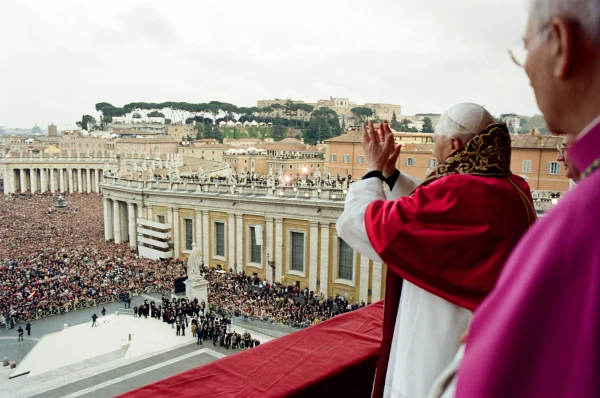
Pope Benedict XVI on the benediction loggia of St. Peter’s Basilica after the announcement of his election as pope April 19, 2005. Vatican Media
Benedict’s papacy was marked by efforts at ecclesiastical, intellectual, and spiritual renewal, including confronting relativism and secularism, combatting the scourge of clergy sexual abuse, pushing for liturgical reform, and promoting further an authentic interpretation of the Second Vatican Council.
In his homily ahead of the 2005 conclave that elected him to the papacy, the soon-to-be pope warned of a “dictatorship of relativism that does not recognize anything as definitive and whose ultimate goal consists solely of one’s own ego and desires.”
He stressed that Jesus Christ is “the measure of true humanism,” and mature faith and friendship with God serve as a criterion to distinguish “the true from the false, and deceit from truth.”
In his speech in Westminster Hall to the leaders of British Society during his visit to the United Kingdom in 2010, he spoke about the immense dangers to contemporary society when religion is driven from the public square.
“There are those who would advocate that the voice of religion be silenced,” he said, “or at least relegated to the purely private sphere. There are those who argue that the public celebration of festivals such as Christmas should be discouraged, in the questionable belief that it might somehow offend those of other religions or none.
“And there are those who argue — paradoxically with the intention of eliminating discrimination — that Christians in public roles should be required at times to act against their conscience,” he said. “These are worrying signs of a failure to appreciate not only the rights of believers to freedom of conscience and freedom of religion, but also the legitimate role of religion in the public square.”
Engaging Islam, encouraging evangelization
Far more controversial was his 2006 address at the University of Regensburg to representatives of science. He criticized forms of secular thought that promote “a reason which is deaf to the divine and which relegates religion into the realm of subcultures,” deeming this attitude “incapable of entering into the dialogue of cultures.” He also criticized schools of Christian and Muslim thought that wrongly exalt God’s “transcendence and otherness” so that human reason and understanding of the good “are no longer an authentic mirror of God.”
Some media and several German politicians purposefully took that speech out of context, focusing on a single, ancient quotation from a Byzantine emperor. This misrepresentation was accompanied by an outburst of anti-Christian violence across parts of the Muslim world.
Despite such reactions, Benedict’s actual contribution led to more significant efforts at a sincere Christian-Muslim dialogue — one that does not paper over differences and that calls for mutual reciprocity in the respect of rights.
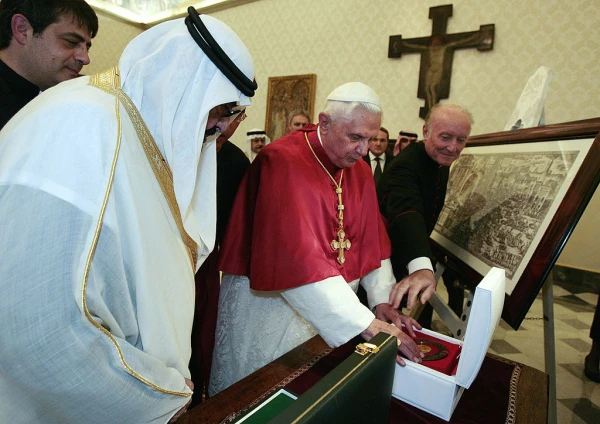
Pope Benedict XVI exchanges gifts with Saudi Arabia’s King Abdullah (left) at the Vatican on Nov. 6, 2007. POOL/AFP via Getty Images
Having recognized the deep existential and spiritual crisis facing the world, the West in particular, Benedict reminded Catholics everywhere of the call to evangelize. He was a major supporter of the new evangelization, especially in preaching and living the Gospel across what he described as the “digital continent,” the world of online communications and social networking.
“There is no greater priority than this: to enable the people of our time once more to encounter God, the God who speaks to us and shares his love so that we might have life in abundance,” he said in his 2010 postynodal apostolic exhortation On the Word of God in the Life and Mission of the Church, Verbum Domini.
Competing views of Vatican II
Benedict saw the need also for the Church to embrace an authentic understanding of the Second Vatican Council, notingin a seminal speech given in 2005 two competing interpretive models (hermeneutics) that had emerged after the council.
The first, a hermeneutic of discontinuity and rupture, proposes that there is a fundamental break between the council and the past and that not the texts but a vague “spirit of the council” should guide its interpretation and implementation. Benedict lamented: “In a word: It would be necessary not to follow the texts of the council but its spirit. In this way, obviously, a vast margin was left open for the question on how this spirit should subsequently be defined and room was consequently made for every whim.”
Against the hermeneutic of rupture, Benedict proposed a hermeneutic of reform and continuity that he called “renewal in the continuity of the one subject-Church which the Lord has given to us. She is a subject which increases in time and develops, yet always remaining the same, the one subject of the journeying People of God.”
His efforts to establish a correct interpretation of the Second Vatican Council lasted through the end of his papacy. On Feb. 14, 2013, just two weeks before his resignation took effect, he said the council was initially interpreted “through the eyes of the media,” which depicted it as a “political struggle” between different currents within the Church.
This “council of the media” created “many calamities” and “so much misery,” with the result that seminaries and convents closed and the liturgy was “trivialized,” he said. Benedict XVI said that the true interpretation of the Second Vatican Council is “emerging with all its spiritual strength.”
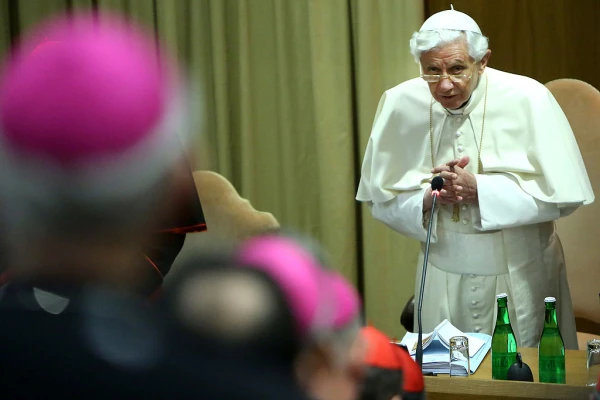
Pope Benedict XVI attends the Synod of Bishops for the New Evangelization for the Transmission of the Christian Faith at the Synod hall on Oct. 19, 2012, in Vatican City. The Synod of Bishops was established by Pope Paul Vl in 1965 after the Second Vatican Council. Photo by Franco Origlia/Getty Images
The call to continuity and reform found rich expression in the pope’s attention to the liturgy, in particular through his great book “Spirit of the Liturgy” (2000) and his efforts to encourage a return to reverence and beauty in liturgy.
“Yes, the liturgy becomes personal, true, and new,” he proposed, “not through tomfoolery and banal experiments with the words, but through a courageous entry into the great reality that through the rite is always ahead of us and can never quite be overtaken.” Above all, his vision for the liturgy placed God once more at the center: “The real ‘action’ in the liturgy in which we are all supposed to participate is the action of God himself. This is what is new and distinctive about the Christian liturgy: God himself acts and does what is essential.”
Putting his concerns into practice, he issued the 2007 apostolic letter Summorum Pontificum, which significantly broadened permission for priests to celebrate Mass according to the missal prior to the reforms of 1970. He wrote in Summorum Pontificum: “In the history of the liturgy there is growth and progress, but no rupture. What earlier generations held as sacred, remains sacred and great for us too, and it cannot be all of a sudden entirely forbidden or even considered harmful. It behooves all of us to preserve the riches which have developed in the Church’s faith and prayer, and to give them their proper place.”
And in answer to the question of whether this reauthorization of the Tridentine Mass was little more than a concession to the schismatic Society of Saint Pius X, Benedict told Peter Seewald in “Last Testament” (2016): “This is just absolutely false! It was important for me that the Church is one with herself inwardly, with her own past; that what was previously holy to her is not somehow wrong now.”
His efforts at reforming the Roman Curia were left incomplete at the time of his resignation. Media attention focused especially on the so-called Vati-Leaks scandal, involving the leak of private papal documents and the arrest and trial of a papal butler. Nevertheless, he took important steps toward genuine financial transparency that were likewise carried forward by Pope Francis.
Similarly, in his years as prefect and then pope, he laid a vital foundation for the Church’s response to the crisis and helped pave the way for further extensive reforms under Pope Francis.
Taking a firm stand on abuse cases
Long before his election as pope, then Cardinal Ratzinger had pushed for serious efforts at confronting the scourge of clergy sexual abuse. In 2001 he was instrumental in having abuse cases placed under the jurisdiction of the Congregation for the Doctrine of the Faith and helped the U.S. bishops receive Vatican approval for the Dallas Charter and the Essential Norms that then formed the basis for the immense progress in dealing with clergy abuse in the United States.
In the days just before the death of Pope John Paul II, in March 2005, Ratzinger wrote meditations for the Way of the Cross on Good Friday in Rome. In his reflection on the ninth station, he made the searing condemnation, “How much filth there is in the Church, even among those who, in the priesthood, should belong entirely to him!” The comments forecast his commitment to the fight against abuse from the moment of his election.
Cardinal Joseph Ratzinger at the Easter Vigil in St. Peter’s Basilica on March 26, 2005, in Vatican City. Photo by Franco Origlia/Getty Images
Two months into his papacy, Benedict disciplined Father Marcial Maciel, the charismatic and influential founder of the Legionaries of Christ who had long been accused of sexually abusing seminarians and was later revealed to have led a deeply scandalous double life.
Hundreds of priests who had committed sexual abuse were laicized under Benedict. This was a continuation of his work at the Congregation for the Doctrine of the Faith, but now it was accompanied by formal apologies to the victims, including those in the United States, Australia, Canada, and Ireland. In 2008, during his visit to the United States, he met personally with victims, and in 2010, he wrote a pastoral letter to the Catholics of Ireland asking their forgiveness for the enormous suffering caused by abuse.
“You have suffered grievously,” he wrote, “and I am truly sorry. I know that nothing can undo the wrong you have endured. Your trust has been betrayed and your dignity has been violated. Many of you found that, when you were courageous enough to speak of what happened to you, no one would listen.”
A distinguished teacher and theologian
Despite his advanced years at the time of his election, Benedict continued John Paul II’s habit of traveling around the world. His 25 apostolic visits outside Italy included three trips to his native Germany and three World Youth Days.
His 2006 visit to Turkey focused on relations with Islam and Orthodox Christianity, featuring his attendance at a Divine Liturgy celebrated by the Orthodox patriarch of Constantinople. During his 2008 visit to the U.S., he visited the site of the destroyed World Trade Center towers, a New York synagogue, and The Catholic University of America in Washington, D.C.
“Christ is the way that leads to the Father, the truth which gives meaning to human existence, and the source of that life which is eternal joy with all the saints in his heavenly Kingdom,” he told 60,000 people gathered for Mass at New York City’s Yankee Stadium in April 2008.
Pope Benedict XVI’s visit to the United States, April 15–20, 2008. Vatican Media
While he did not set the record for the most beatifications and canonizations, Benedict canonized 45 new saints, including Damien de Veuster, the leper priest of Molokai (2008); the French Canadian André Bessette (2010); and Kateri Tekakwitha (2012), the first Native American saint. He had the unique distinction of allowing the start of the cause of canonization of his predecessor, John Paul II, and had the great pleasure of presiding at his beatification in 2011. (St. John Paul II was canonized in 2014 by Pope Francis.)
He also named two doctors of the Church in 2012, the medieval German mystic and abbess St. Hildegard of Bingen and the Spanish priest St. John Ávila.
His three encyclicals, Caritas in Veritate, Spe Salvi, and Deus Caritas Est, stressed the theological virtues of love and hope. Pope Francis incorporated Benedict’s unfinished encyclical on faith into his own 2013 encyclical Lumen fidei.
Each encyclical offered the deep reflections of one of the Church’s great theologians. Similar significance can be attached to his post synodal apostolic exhortations, the fruits of the Synods of Bishops held under his guidance. His 2007 exhortation Sacramentum Caritatis, on the Eucharist as the “Source and Summit of the Church’s Life and Mission,” anticipated the call in recent years for a eucharistic revival.
“The sacrament of charity,” Benedict wrote, “the Holy Eucharist is the gift that Jesus Christ makes of himself, thus revealing to us God’s infinite love for every man and woman … What wonder must the eucharistic mystery also awaken in our own hearts!” (SC, 1).
Benedict’s fame as a theologian and author already was established internationally before his election to the papacy. His books included “Introduction to Christianity,” a compilation of his university lectures on the faith in the modern world. His interview books were major best-sellers, including “The Ratzinger Report” (1985) with Vittorio Messori, “Salt of the Earth” (1996), “God and the World” (2000), and “Light of the World” (2010) with the German journalist and author Peter Seewald. One of the popular works under his name was the trilogy “Jesus of Nazareth,” an effort to explain Jesus Christ to the modern world.
A pope emeritus
Benedict led a life of prayer and reflection after the election of Pope Francis, occasionally consulting and meeting with his successor. Ultimately, his time in retirement and seclusion was longer than his pontificate.
He was present for the canonization of John Paul II and Pope John XXIII at St. Peter’s on April 27, 2014. In addition, he attended the launch of the Holy Year of Mercy on Dec. 8, 2015.
Occasional public interventions sparked intense reactions and debate. In 2019, he contributed to the discussion on the abuse crisis with an essay, going to the heart of the matter — the dictatorship of relativism that he had warned about in 2005.
“Today, the accusation against God is, above all, about characterizing His Church as entirely bad, and thus dissuading us from it. The idea of a better Church, created by ourselves, is in fact a proposal of the devil, with which he wants to lead us away from the living God, through a deceitful logic by which we are too easily duped,” he wrote.
“The Church of God also exists today, and today it is the very instrument through which God saves us.”
Pope Francis visits Benedict XVI on Aug. 27th, 2022. Vatican Media
In July 2021, the then 94-year-old retired pope warned of a Church and doctrine without faith, saying: “Only faith frees man from the constraints and narrowness of his time.”
In February 2022, the pope emeritus issued a letter addressing a report on abuse in the Archdiocese of Munich-Freising that faulted him for his handling of abuse cases during his time as archbishop in the late 1970s. In it he once again expressed to all the victims of sexual abuse his profound shame, his deep sorrow, and his heartfelt request for forgiveness.
The letter served in many ways, too, as a final meditation on his life in retirement but also the abiding faith that characterized his labors on behalf of Christ and his Church.
“Quite soon,” he wrote, “I shall find myself before the final judge of my life. Even though, as I look back on my long life, I can have great reason for fear and trembling, I am nonetheless of good cheer, for I trust firmly that the Lord is not only the just judge, but also the friend and brother who himself has already suffered for my shortcomings, and is thus also my advocate, my ‘Paraclete.’
“In light of the hour of judgment, the grace of being a Christian becomes all the more clear to me,” he continued. “It grants me knowledge, and indeed friendship, with the judge of my life, and thus allows me to pass confidently through the dark door of death.”
Pope Francis is expected to celebrate Benedict XVI’s funeral Mass.
The Vatican said on Friday that Pope Emeritus Benedict XVI had rested well and that his condition was unchanged.
In a statement published Dec. 30, the Holy See Press Office said: “Last night the Pope Emeritus was able to rest well. He also participated in the celebration of Holy Mass in his room yesterday afternoon. At present his condition is stationary.”
On Thursday, Pope Francis renewed his invitation to pray for Benedict “and accompany him in these difficult hours.”
At the end of his general audience on Dec. 28, the pontiff had asked for prayers for his predecessor, sparking concerns over the health of the 95-year-old.
The Diocese of Rome offered a special Mass for Pope Emeritus Benedict XVI at the Basilica of St. John Lateran later on Friday.
Jesus Christ is the light of the world: come, let us adore him!
Glory to the Father, and to the Son, and to the Holy Spirit, as it was in the beginning, is now, and will be for ever. Amen. Alleluia!
Hymn
Meter: LM This hymn can be sung to the tune used for On Jordan’s Bank
The great forerunner of the morn, The herald of the Word, is born; And faithful hearts shall never fail With thanks and praise his light to hail.
With heav’nly message Gabriel came, That John should be that herald’s name, And with prophetic utt’rance told His actions great and manifold.
John, yet unborn, gave still aright His witness to the coming Light, And Christ, the Sun of all the earth, Fulfilled that witness at his birth.
Psalm 25:1-6
Lo, I am sending my messenger/ to prepare the way before me. (Mal 3:1)
John, the last great prophet, is the lamp, but Jesus Christ is the morning star for which the dark world yearns in hope.
To you, O Lord, I lift up my soul. I trust you, let me not be disappointed; do not let my enemies triumph. Those who hope in you shall not be disappointed, but only those who wantonly break faith.
Lord, make me know your ways. Lord, teach me your paths. Make me walk in your truth, and teach me: for you are God my savior.
In you I hope all day long because of your goodness, O Lord. Remember your mercy, Lord, and the love you have shown from of old.
Glory to the Father….
Word of God. 2 Peter 1:19
We possess the prophetic message that is altogether reliable. You will do well to be attentive to it, as to a lamp shining in a dark place, until day dawns and the morning star rises in your hearts.
Jesus Christ is the Morning Star!
Canticle of Zechariah
The daybreak from on high will visit us/ to shine on those who sit in darkness and death’s shadow,/ to guide our feet into the path of peace. (Lk 1:78-79)
Blessed be the Lord, the God of Israel; he has come to his people and set them free. He has raised up for us a mighty savior, born of the house of his servant David.
Through his holy prophets he promised of old that he would save us from our enemies, from the hands of all who hate us.
He promised to show mercy to our fathers and to remember his holy covenant.
This was the oath he swore to our father Abraham: to set us free from the hands of our enemies, free to worship him without fear, holy and righteous in his sight all the days of our life.
You, my child, shall be called the prophet of the Most High; for you will go before the Lord to prepare his way, to give his people knowledge of salvation by the forgiveness of their sins.
In the tender compassion of our God the dawn from on high shall break upon us, to shine on those who dwell in darkness and the shadow of death, and to guide our feet into the way of peace.
Glory to the Father…
Intercessions
To Jesus Christ, the light of the world, we pray:
R/Come and reward your people’s hope!
You come as the dawn of the everlasting day: – sustain in courage those who keep vigil through the long night of suffering. R/
You come as the sun of justice to drive away the darkness of death: – sustain in hope and faith the terminally ill and those who watch beside them. R/
You come as the light of the world: – sustain in joy all who are called to proclaim the Gospel amid the clamor of this busy season. R/
Personal intentions
Our Father….
Lord Jesus Christ, you are the light in which we place our hope. Break upon minds clouded by confusion, hearts darkened by self-seeking, spirits dimmed by deadening habits, and set your people free to welcome your coming with joy, who live and reign with the Father in the unity of the Holy Spirit, God, for ever and ever. Amen.