Friday, April 3, 2026
14.2 C
London
Home Blog Page 34

Body of Benedictine Sisters’ Foundress Thought to Be Incorrupt

0

In recent days, a Benedictine monastery in rural Missouri has attracted hundreds of pilgrims following the news that the remains of Sister Wilhelmina Lancaster, the African American foundress of the contemplative Benedictine Sisters of Mary, Queen of the Apostles, may be incorruptible. Despite her death and burial in a simple wooden coffin four years ago, her body appears to have remained remarkably preserved.

20230522110520 256bb8b9309cb312963a70d01f9555fe22901d55817d32ad478d7adeaa60148b
photo: Kelsey Wicks

Sister Wilhelmina Lancaster established the Benedictine Sisters of Mary, Queen of the Apostles in 1995 at the age of 70, leaving her previous community, the Oblate Sisters of Providence, after more than 50 years of service. She was known for her dedication to the traditional Latin Mass, Benedictine contemplation, and the Liturgy of the Hours. At the age of 95, on May 29, 2019, the Solemnity of the Ascension, she passed away.

On the same feast day four years later, the abbess and sisters decided to transfer her body to a final resting place within their monastery chapel, as is customary for founders and foundresses. However, instead of finding only bones, the Benedictine sisters discovered a coffin containing a seemingly intact body. Remarkably, despite the absence of embalming and the presence of a crack in the wooden coffin that allowed moisture and dirt to enter over the course of those four years, the body had not decayed significantly.

Mother Cecilia, the current abbess of the community, stated, “We believe she may be the first African American woman to be found incorrupt.” As the head of the monastery, she was the first to examine the contents of the coffin. Although the body was covered in mold due to the high levels of condensation within the cracked coffin, very little decomposition had occurred.

The discovery left the community in awe. Initially, the abbess thought she saw a fully intact foot, which took her by surprise. Upon closer examination, she confirmed the presence of the foot, leading to a jubilant cheer from the gathered community. There was a profound sense that this was a divine act, bringing hope, faith, and trust to those in need.

The Catholic Church has a long-standing tradition of venerating “incorruptible saints,” over a hundred of whom have been beatified or canonized. These saints are referred to as incorruptible because their bodies, or parts thereof, resist the natural process of decay. Even with modern embalming techniques, bodies are subject to decomposition. The preservation of incorruptible bodies is seen as a testament to the reality of the resurrection of the body and the eternal life that awaits believers. It is also regarded as a sign of holiness, demonstrating a life lived in close union with Christ, where corruption is miraculously held at bay.

Clarifying rumors, the abbess emphasized that there was no flood opening the grave or a midnight examination by flashlight, as exaggerated in some accounts. The process of examining the coffin required a flashlight due to the lack of visibility in the dark crack. Mindful of the crack and the dirt, the sisters carefully removed the body. Although the skeletal remains should have weighed around 20 pounds, they estimated the body to weigh between 80 and 90 pounds.

The sisters have compiled a fact sheet to address inquiries about the exhumation. They reported that Sister Wilhelmina’s body was remarkably preserved, with her crown, bouquet of flowers, profession candle, crucifix, and rosary all intact. Particularly noteworthy was the preservation of her holy habit, made from natural fibers, which Sister Wilhelmina strongly advocated for throughout her religious life. The synthetic veil remained perfectly intact, while the coffin’s lining, made of similar material, had completely deteriorated.

The abbess underscored the significance of the habit

‘s preservation, as it serves as a powerful symbol that life extends beyond the present realm. Observers see the habit as a reminder of the transcendental and of the ultimate destination: heaven, hell, and purgatory. Such preservation is not naturally possible, affirming the reality of God’s protection and serving to reignite and strengthen faith.

Regarding the next steps, the abbess explained that there is no instruction manual on what to do with an incorruptible body. Initially, they cleaned Sister Wilhelmina’s body with hot water, removing a thick layer of mold from her face. Exposure to air and the cleaning process caused a partial loss of volume and a darkening of the skin. To restore her appearance, the sisters created a wax mask for her face, while also applying wax to her hands.

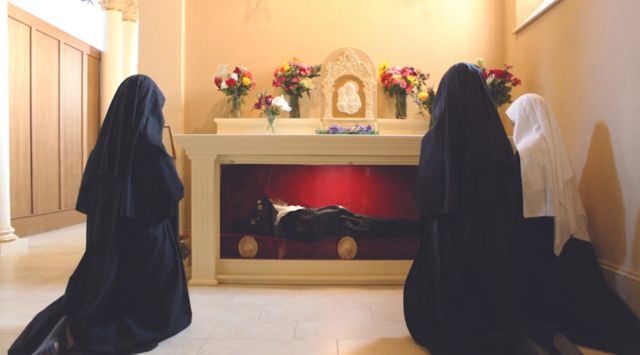
The body will be displayed in the sisters’ chapel until May 29, when a Rosary procession is planned. Afterward, Sister Wilhelmina’s body will be placed in a glass case near the altar of St. Joseph in the chapel, allowing an increasing number of devotees to pay their respects.

News of the incorruptible body quickly spread through text messages and social media, attracting hundreds of pilgrims from far and wide. Many traveled long distances, such as from Kentucky, Illinois, and neighboring areas of Missouri, to visit the incorrupt sister. They came to pray before her body and to learn more about this woman who is regarded as deeply holy.

Pilgrims expressed their profound emotions upon witnessing the incorruptible body. Many were moved to tears, feeling a genuine and significant connection. For them, it was a meaningful and authentic experience. Amidst a world filled with chaos and darkness, the sight of Sister Wilhelmina’s preserved body served as a reminder of what awaits in the future—a glimpse of God’s grace and a testament to the enduring hope for believers.

The abbess believes that the preservation of Sister Wilhelmina’s body conveys the same message through the lens of her Catholic faith: heaven is real, and the resurrection is a certainty, especially during these challenging times for the Church and the world. Her message to all is one of hope, imploring people to have faith, knowing that God listens, loves, and remains present.

While the Church has not yet declared Sister Wilhelmina’s case miraculous or acknowledged her incorruptibility, both the sisters of her community and the pilgrims visiting the monastery recognize that something extraordinary is occurring in Gower, Missouri. It is a profound reminder that life continues beyond death, a miracle that rekindles faith and inspires belief in the eternal journey that lies ahead.
Conjoined Twins’ Amazing Sacramental Journey Before Passing

0

The heartwarming tale of Nicole and Austin LeBlanc, a devout Catholic couple hailing from Michigan, has deeply touched the hearts of many. Initially shared by CNA on April 27, their inspiring journey was recounted during an interview with EWTN News Nightly, shedding light on their experiences upon discovering they were expecting conjoined twins.

6058cccf 7ea4 494a a823 b0c439543b25 1
Rachel Clare and Maria Therese LeBlanc were born alive and were baptized and confirmed before taking their last breaths. Photo courtesy of Nicole and Austin LeBlanc

These precious girls, Rachel Clare and Maria Therese, shared vital organs including a heart. As soon as medical professionals labeled the pregnancy as high-risk and recommended termination, Nicole firmly believed that she carried two extraordinary little blessings.

Originally slated for an early June cesarean section, the surgery was rescheduled due to their growth stalling, along with their heart rate. At 32 weeks’ gestation, the LeBlancs were finally able to meet their babies on May 16.

Rachel Clare and Maria Therese were born alive, receiving immediate baptism and confirmation.

In an Instagram post, Nicole expressed, “For about an hour, they lived until their last breaths. Austin and I showered our girls with love until their final moments, encompassing their entire lives with nothing but love.”

fa2804e0 9a84 4c27 a749 0a20804dbb2d 1

She continued, “God designed them so exquisitely within my womb, and it was a tremendous honor and privilege to carry them for as long as I could. Their presence has touched countless lives, and the overwhelming support my family has received has been truly remarkable.”

Upon learning the news, Nicole turned to social media to share their remarkable journey with others, intending to serve as a beacon of love and hope.

Throughout their ordeal, the couple placed their unwavering faith to the test and found solace in praying the rosary together daily.

Austin shared during the EWTN News Nightly interview, “Every night, we come together and pray the rosary. It holds great significance for us… and knowing that God has a purpose for everything and a plan for everything.”

In addition to their unwavering faith, the couple drew inspiration from several saints and biblical figures, as reflected in the names they chose for their twin girls.

“We desired for our babies to be offerings to the Blessed Mother, so we named one of them Maria, the Latin name for Mary,” explained Nicole. “And personally, I have always felt a special connection with the Old Testament tale of Rachel, which led us to name our other daughter Maria Therese and Rachel Clare.”

Throughout her pregnancy, Nicole received an outpouring of prayers and support from both Catholics and non-Catholics alike.

In a tweet, Nicole shared that her beloved baby girls are now “delighting in the wonders of the beatific vision.”

A prayer before work

0

I was promoted at the end of March and I love my new job! I’m blessed to have a boss that wants me to succeed and is very helpful. She is more than willing to answer my texts on her days off or she will call the office so she can walk me through something I’m stuck on.

I have to admit, my confidence level goes up and down and I have days where I sit staring at the computer screen wondering what to do.

I found this prayer in my Laudate App which is free on iTunes. Before I start work, I sit in the breakroom and read it carefully from my phone. It has helped me tremendously. It’s beautiful and it covers every aspect of the work day.

I’m sharing it here:

Morning prayer before starting work

My heavenly Father, as I enter this work place, I bring your presence with me.
I speak your peace, your grace, your mercy and your perfect order into my work.
I acknowledge your power over all that will be done, spoken, thought and decided within these walls.
Lord, I thank you for the gifts you have blessed me with.
I commit to use them responsibly in your honor.
Give me a fresh supply of strength to do my job.
Anoint my projects, ideas, and energy, so that even my smallest accomplishment may bring you glory.

Lord, when I am confused, guide me.
When I am weary, energize me.
When I am burned out, infuse me with the light of the Holy Spirit.
May the work that I do and the way I do it bring faith, joy and a smile to all that I come in contact with today.
And oh Lord, when I leave this place, give me traveling mercy.
Bless my family and home to be in order as I left it.
Lord, I thank you for everything you’ve done, everything you are doing, and everything, you are going to do.
In the name of Jesus I pray, with much love and thanksgiving.
In the name of the Father, and of the Son, and of the Holy Spirit, Amen.

Read More

A Short Powerful Prayer from Jesus for Those in Need of Hope

When darkness clouds the heart and the future feels uncertain, few words pierce through despair as powerfully as these: Jesus, I trust in You.

This simple yet profound prayer—revealed by Jesus Himself to St. Faustina Kowalska in the early 20th century—summarizes the entire Christian life. It is both a confession of faith and a cry of surrender, a plea that binds us to God’s mercy when all else fails.

The Prayer that Summarizes the Gospel

St. Faustina, a humble Polish nun, was chosen by Christ to proclaim His message of Divine Mercy to the world. In her Diary, Jesus told her, “The graces of My mercy are drawn by means of one vessel only, and that is trust. The more a soul trusts, the more it will receive” (Diary, 1578).

Trust, therefore, is not merely an emotion—it is the vessel that carries the soul to the very heart of God. Through it, the Lord pours out His inexhaustible mercy upon the world. As Jesus said to her, “Let no soul fear to draw near to Me, even though its sins be as scarlet.” (Diary, 699)

In our anxiety, fear, and loss of hope, the Lord asks of us one thing above all: trust. That is why this short prayer—“Jesus, I trust in You”—has become one of the most complete prayers a Christian can say. In just a few words, it acknowledges who He is, who we are, and where our hope lies.

The Foundation of Hope: Christ’s Own Words

Jesus Himself, during His earthly life, gave us several prayers and teachings that anchor us in hope when life becomes heavy. Among them are:

  1. “Thy will be done.”
    (Matthew 6:10)
    In the Lord’s Prayer, Jesus teaches us to abandon ourselves to the Father’s plan. Hope grows when we stop clinging to control and rest in God’s will.
  2. “Come to Me, all who labor and are heavy laden, and I will give you rest.”
    (Matthew 11:28)
    This invitation is not poetic—it is literal. Christ calls the weary to Himself. Hope begins not when problems disappear, but when we come to the One who carries them with us.
  3. “Peace I leave with you; My peace I give to you.”
    (John 14:27)
    When the world offers anxiety, Jesus offers Himself. His peace is not escape from trouble but strength within it.
  4. “Do not be afraid; just believe.”
    (Mark 5:36)
    These words, spoken to Jairus when his daughter died, remind us that faith can live even in the shadow of death. Christ’s command to believe is always an invitation to hope.
  5. “Father, into Your hands I commend My spirit.”
    (Luke 23:46)
    Even in His agony, Jesus shows us the path of trust. His final words on the Cross are the most complete act of hope ever uttered.

Each of these prayers from Jesus contains the same spirit that He gave to St. Faustina: complete surrender to the love and providence of God.

The Lesson of the Birds

Jesus taught His disciples to look at creation as a living parable of God’s care:

“Look at the birds of the air: they neither sow nor reap nor gather into barns, and yet your heavenly Father feeds them. Are you not of more value than they?… Seek first the kingdom of God and His righteousness, and all these things shall be yours as well.”
(Matthew 6:26–27, 33)

Hope begins when we shift our gaze—from our fears to the Father’s hands. It is not naive optimism, but supernatural confidence that God is faithful even when life is not.

The Prayer of Trust in Daily Life

When you are burdened, when your plans collapse, when the news terrifies you or your own sins weigh you down—whisper the words Jesus gave to St. Faustina:
“Jesus, I trust in You.”

Say it when you cannot see the way ahead. Say it when you feel you’ve failed. Say it when hope seems lost. Each time you say it, grace enters a little deeper. Each repetition carves a channel through which Divine Mercy flows into your heart.

St. Faustina herself testified: “When I say this prayer with trust, a peace floods my soul, and I feel that Jesus Himself takes over my concerns.” (Diary, 1406)

A Final Prayer for Hope

Let us pray:

Lord Jesus Christ,
You taught us to trust the Father’s will,
to seek first His Kingdom,
and to rest in the peace You give.

When fear darkens our hearts,
and hope begins to fade,
teach us to say with childlike faith:
Jesus, I trust in You.

May this trust open our hearts to Your mercy,
heal our wounds,
and draw us ever closer to the light of Your Resurrection.
Amen.

Read More

Prayer to Mary in times of trial

Say this prayer to Mary in times of trial

Most holy and Immaculate Virgin, Help of Christians, we place ourselves under your motherly protection. Throughout the Church’s history you have helped Christians in times of trial, temptation and danger.

Time and time again, you have proven to be the Refuge of sinners, the Hope of the hopeless, the Consoler of the afflicted, and the Comforter of the dying. We promise to be faithful disciples of Jesus Christ, your Son, to proclaim His Good News of God’s love for all people, and to work for peace and justice in our world. With faith in your intercession, we pray for the Church, for our family and friends, for the poor and abandoned, and all the dying.

Grant, O Mary, Help of Christians, the graces of which we stand in need.

(Mention your intentions.)

May we serve Jesus with fidelity and love until death. Help us and our loved ones to attain the boundless joy of being forever with our Father in heaven.

Amen.

Read More

Real Exorcists Raise Concerns About Russell Crowe’s New Movie

0
File:Russell Crowe at diff in 2015.jpg

The trailer for the upcoming movie “The Pope’s Exorcist,” which stars Russell Crowe as Father Gabriel Amorth, has generated significant concern among exorcists and members of the International Association of Exorcists, an organization that Father Amorth helped to found. The group’s statement, released on March 7, 2023, suggests that the film may not do justice to the real-life experiences of Father Amorth and the practice of exorcism as it is conducted within the Catholic Church.

According to the International Association of Exorcists, the movie trailer indicates that “The Pope’s Exorcist” falls under the category of “splatter cinema,” a sub-genre of horror films that feature graphic violence and gore. The group expressed concern that the movie’s depiction of exorcisms seems to be exaggerated and unrealistic, with excessive physical and verbal manifestations that are typical of horror films.

Furthermore, the group claimed that the use of high-contrast chiaroscuro effects in the film gives it a Da Vinci Code-like quality, suggesting to viewers that they should be suspicious of both the devil and the Church’s power. While special effects are expected in any film dealing with demonic possession, the group argued that “The Pope’s Exorcist” goes too far and distorts the reality of what is experienced during exorcisms.

The statement also noted that the movie’s portrayal of exorcism could be offensive to those who are genuinely suffering from the effects of demonic possession. The group promised to release a more in-depth response to the film’s April 14 theatrical release.

Despite the concerns expressed by the International Association of Exorcists, it is important to recognize that “The Pope’s Exorcist” is a work of fiction inspired by the real-life experiences of Father Gabriel Amorth. It is not intended to be a documentary or a historically accurate portrayal of exorcism within the Catholic Church.

Father Amorth, who passed away in 2016, was a highly respected and well-known exorcist who authored several books on the subject of exorcism, including “An Exorcist Tells His Story.” The upcoming movie is reportedly based on his book and is intended to be a fictionalized account of his experiences as an exorcist.

While there may be concerns about the accuracy of the movie’s portrayal of exorcism, it is important to remember that it is a work of fiction and should be viewed as such. It is also an opportunity for viewers to learn more about the life and work of Father Gabriel Amorth, a man who dedicated his life to helping others through his work as an exorcist.

The Significance of the Sanctuary in the Church

0

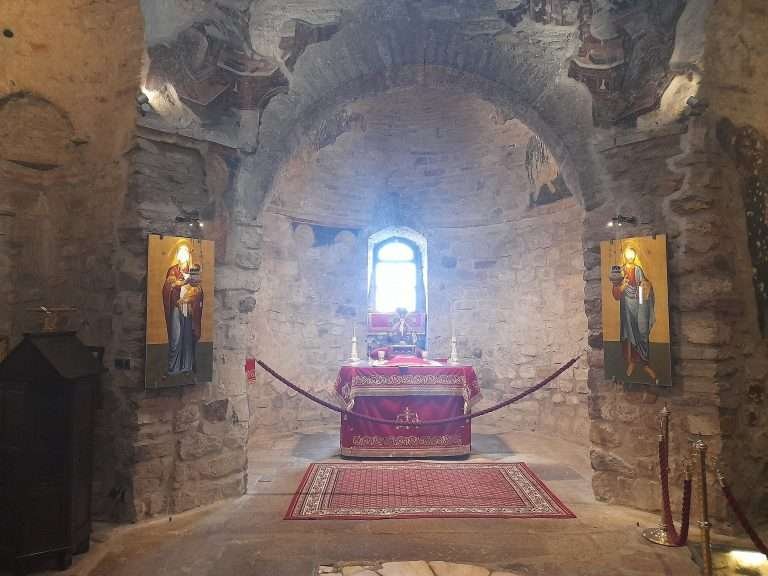
In every Catholic church, there is a sacred space known as the sanctuary. It is a place where the primary actions of the Mass take place, where the priest conducts the sacred rituals and offers sacrifice to God on behalf of the congregation. The word “sanctuary” is derived from the Latin word “sanctus” which means holy, sacred, or set apart. In essence, the sanctuary is a place that is consecrated and dedicated to the worship of God.

The concept of a sanctuary dates back to ancient times, where it was believed that certain locations were imbued with spiritual power and significance. In the Judeo-Christian tradition, the sanctuary was designed to mimic the holy of holies in the Jerusalem temple. It was the most sacred and holy place in the temple, where only the priests were allowed to enter and offer sacrifices to God.

The holy of holies was separated from the rest of the temple by a thick veil, which symbolized the separation between God and man. The actions of the priest were invisible to the rest of the people, who could only hear and sense the presence of God. In Byzantine churches, this concept is still carried out with an iconostasis, an entire wall that blocks the view of the sanctuary from the rest of the church.

In Roman Catholic churches, the use of the sanctuary veil gradually decreased over time. However, the altar rail remained as the last remaining remnant of this tradition in the West. The altar rail is a symbolic barrier that separates the sanctuary from the rest of the church, reminding us of the sacredness of the space and the importance of approaching it with reverence and awe.

The sanctuary is also distinguished by the presence of the tabernacle, a small box that contains the consecrated Eucharistic hosts. In most churches, the tabernacle is placed in the sanctuary as a reminder of the Real Presence of Christ in the Eucharist. The presence of the tabernacle is indicated by a red lamp, which serves as a visual reminder of the presence of God.

In conclusion, the sanctuary is a holy and sacred place, reserved for a specific function and designed to facilitate our worship of God. It is a physical reminder of the spiritual realities that underlie our faith, and it serves as a place of encounter between God and His people. As we approach the sanctuary, may we do so with a spirit of reverence and humility, recognizing the sanctity of the space and the greatness of the God we worship.

Things you should know about the Annunciation of the Lord

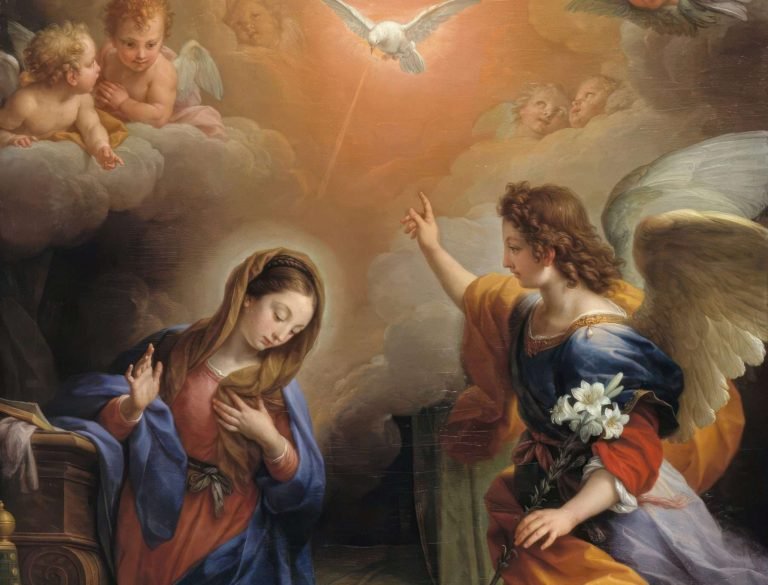
The solemnity of the Annunciation is a day of great celebration, commemorating the moment when the Angel Gabriel appeared to the Virgin Mary to announce the miraculous birth of Christ. Here are eight important things to know about this significant day.

Firstly, the word “Annunciation” comes from the same root as “announce,” as Gabriel announces the birth of Christ in advance. While this term is often associated with Christ’s birth, it can be applied in other ways, as evidenced in the book Jesus of Nazareth 3: The Infancy Narratives.

The Solemnity of the Annunciation is typically celebrated on March 25, which is nine months before Christmas, and it is believed that this was the amount of time Jesus spent in the womb. However, when this date falls during Holy Week, it is moved to the Monday after the Second Sunday of Easter.

The stories of the Annunciation and the birth of John the Baptist share many parallels, such as the Angel Gabriel making the announcement, announcing a miraculous birth, offering a miraculous sign as evidence, and then departing. However, Mary’s reaction to Gabriel is fundamentally different from Zechariah’s, as her question is one of faith seeking understanding, not skepticism.

Mary’s question also provides insight into her perpetual virginity. The literal translation of her question is “since I do not know man,” using the biblical euphemism for sexual relations. Her question indicates that she was not planning on an ordinary marriage, which is supported by early Christian writings indicating that Mary was a consecrated virgin.

When Gabriel responds to Mary’s question, he explains that the Holy Spirit will come upon her and the power of the Most High will overshadow her, and that the child to be born will be called holy, the Son of God. This highlights the involvement of all three Persons of the Trinity in the conception of Jesus.

Finally, it is worth noting that Elizabeth is not necessarily Mary’s cousin, as some might think. The term “brothers” of the Lord could refer to cousins or other relatives, but it is not a definitive statement on the matter.

Starting your prayer life

0

Prayer is an essential aspect of our spiritual lives, yet many of us struggle with it. However, this is normal because prayer, like any relationship, takes work to develop. At first, we base our prayers on good emotions and experiences, but true love and connection with God can only be fostered when we move beyond relying on these highs. We must learn to love God for who He is and not just for what He does for us. This kind of love takes effort, and there will be times when prayer feels dry and distant. During these times, we should seek help from a spiritual director or confessor and continue to pray, even when it feels difficult. Choosing to pray, even when we don’t feel like it, is a sign of true love.

Dry times in prayer can be seen as a gift from God because they allow us to move beyond our feelings and go deeper in our relationship with Him. It’s important to remember that prayer is not about having great emotions or experiences; it’s about choosing to love and connect with God regardless of how we feel. In fact, 20 minutes of prayer where we struggle and feel dry can be more pleasing to God than 20 minutes of easy prayer with great emotions.

To overcome difficulties in prayer, we must understand why we pray. We are commanded to pray at every opportunity and the Holy Spirit helps us when we don’t know how to pray. Prayer is essential for success in fulfilling God’s vision for our lives. However, there are many reasons why we let our prayer lives slip, including discouragement, doubt, impatience, temptations, laziness, dryness, and physical, mental, or emotional problems.

To improve our prayer lives, we should frequent the sacraments, establish a prayer routine, set aside a specific time and place for prayer, use devotional aids, pray with scripture, pray with others, take time for silent contemplation, practice gratitude, cultivate a spirit of detachment, make a daily examination of conscience, offer up our sufferings, ask for intercession from the saints, practice self-care, and never give up on prayer. With perseverance and faith, we can make prayer the center of our lives and deepen our personal relationship with Jesus.

Ways we limit God’s power in our lives

0

Many of us fear what God may ask of us, but fear is a significant barrier to faith. It was fear that kept the Apostles trapped in the upper room, while faith propelled them onto the streets and transformed the world. Faithlessness hinders God from working through us, but faith unlocks His power in our lives. The Bible confirms this when Jesus said, “A prophet is not without honor except in his hometown and among his own relatives and in his own household.” Even though Jesus wanted to perform miracles, their unbelief limited His power. Our lack of faith hinders God from working through us, and He does not compel Himself upon us. He wants us to accept His grace, love, and power freely, out of love for Him. Though fear of the unknown is natural, faith (fortified by hope) intervenes when we are powerless, and supernaturally enables us to access God’s power in our lives. Therefore, the Christian faith’s heart is to BELIEVE and be saved, BELIEVE and be healed.

However, we often rely on our own power instead of God’s omnipotent and infinite power. We hold ourselves back from the one who is all-powerful and all-loving. Our imperfection and weakness make us question why God would love us. Rather than opening up to God, we rely on our limited understanding, abilities, and power. Consequently, we wonder why we have not grown in holiness or why our prayers have not been fruitful. God knows better than we do, and we need to trust Him completely. To surrender our lives to Him, we must eliminate anxiety and worry. The Bible frequently reminds us not to worry or have fear. If we seek God for His sake, and not merely for what He can do for us, we will be rewarded. Jesus affirmed this when He said, “Consider how the wild flowers grow. They do not labor or spin. Yet I tell you, not even Solomon in all his splendor was dressed like one of these. If that is how God clothes the grass of the field, which is here today, and tomorrow is thrown into the fire, how much more will He clothe you—you of little faith! And do not set your heart on what you will eat or drink; do not worry about it. For the pagan world runs after all such things, and your Father knows that you need them. But seek His kingdom, and these things will be given to you as well.”

Furthermore, we tend to hold onto the guilt of our sins even after we repent of them. Sin is possessive and hates seeing its slave being freed. It lingers on as guilt and beats us down, causing us to doubt whether we are truly forgiven. It is easy to fall back into the same old sin again and again, and we question if we are genuinely repentant. True repentance necessitates honesty, humility, and determination to turn away from sin. However, we cannot rely solely on our strength to achieve this. We must know that God no longer condemns us and that we are genuinely free. Therefore, we must not shackle ourselves to guilt from forgiven sin and allow God to work wonders in our lives. As the Bible states, “It is for freedom that Christ has set us free. Stand firm, then, and do not let yourselves be burdened again by a yoke of slavery.”

Lastly, many Christians struggle with prayer and their relationship with Jesus because they are merely searching for spiritual highs and good feelings rather than a genuine connection. When we pray, do we relinquish our burdens to God or cling to them as our own possessions? Are we genuinely attempting to love and seek God’s will